 WOWOW Faucets
A shower faucet attachment is any add-on device that connects to your existing tub faucet, spout, or shower arm to give you something you didn’t have before — a handheld sprayer, a stronger stream, a second shower head, a filter, or a diverter to switch between them. Instead of ripping open the wall and re-plumbing your valve (a $400–$1,500 job), you’re threading or clamping a part onto hardware that’s already there. For renters, older homes with tub-only bathrooms, and anyone who just wants more water pressure, it’s the single cheapest upgrade in the whole bathroom.
Below, I’ll walk through the actual questions people ask before buying one: which type fits your spout, how to add a shower to a tub that only has a faucet, why your pressure is weak, and what you’ll realistically pay in 2026. I’ll keep it concrete — real thread sizes, real install times, real trade-offs.
What exactly counts as a “shower faucet attachment”?
A shower faucet attachment is a broad category, not one product. It covers any part that connects to existing faucet or shower plumbing to change how the water comes out. The five most common types are diverters, handheld shower kits, adapters, filters, and flow boosters.
Here’s the plain-language breakdown of what each one does and who it’s for:
- Tub spout diverter attachment — replaces or clips onto your tub spout so you can pull a knob and send water up to a shower head. This is how you turn a bathtub-only setup into a shower.
- Handheld shower attachment — a hose-and-sprayer combo that connects to the shower arm or the tub spout, great for rinsing hair, kids, pets, and cleaning the tub.
- Adapter / fitting — a small brass or plastic piece that converts one thread type or size to another so two mismatched parts can join (for example, a spout with no threads to a hose).
- Filter attachment — screws in-line before the shower head to reduce chlorine and hard-water minerals.
- Flow booster / high-pressure head — an attachment that narrows and shapes the spray to make weak pressure feel stronger.
Most “shower faucet attachment” searches are really about one of two goals: add a shower where there isn’t one, or make the shower I have work better. The rest of this article is organized around those two goals.
How do I add a shower to a bathtub that only has a faucet?
To add a shower to a tub with only a faucet, install a slip-on or screw-on diverter shower faucet attachment on the tub spout, then run its hose up to a wall bracket holding a handheld or fixed shower head. It’s a no-plumber job that takes 10–20 minutes and costs $30–$120.
The key question is what your current spout looks like, because that decides which attachment you buy:
| Your tub spout type | Attachment you need | Install difficulty | Typical price |
|---|---|---|---|
| Threaded front (visible threads at the tip) | Screw-on diverter spout attachment | Easy — hand-tighten with tape | $20–$50 |
| Smooth / no threads | Clamp-on diverter with rubber gasket | Easy — tighten set screw | $25–$60 |
| Slip-fit spout (set screw underneath) | Replacement diverter spout, same bore | Moderate — loosen set screw, swap | $25–$70 |
| Existing shower arm above tub | Handheld kit that mounts to the arm | Easiest — no spout work | $30–$120 |
If your tub spout has no set screw at all, it’s almost always a threaded spout that unscrews by twisting counterclockwise — worth confirming before you buy, because it changes your options. We cover that exact scenario in our guide on how to handle a tub spout with no set screw. And if you specifically want a wand you can hold, our roundup of the best handheld shower head that connects to a tub faucet compares real models by hose length, spray modes, and diverter quality.
One honest limitation: a spout-diverter attachment sends water up through a thin hose, so the pressure at a wall-mounted head won’t match a properly plumbed overhead shower. It’s fantastic for a handheld you hold close, and perfectly usable as a standing shower — just set expectations.
Do I need a plumber for a shower faucet attachment?
No — the whole point of a shower faucet attachment is that you don’t need a plumber. Every attachment in the table above connects to hardware that’s already installed, using either hand-tight threads, a set screw, or a clamp. The only tools you’ll typically need are plumber’s tape (PTFE tape) and sometimes an adjustable wrench or a hex key. If you find yourself needing to open the wall or touch the mixing valve, that’s no longer an attachment job — that’s a remodel, and that’s when a pro makes sense.
Which shower faucet attachment fixes weak water pressure?
For weak pressure, the right attachment depends on the cause: a high-pressure shower head or flow-restrictor removal fixes low flow, while a filter or cleaning fixes clogs. Start by figuring out whether your water is genuinely low-pressure or just blocked by mineral buildup.
Here’s the diagnostic order I’d follow before spending money:
- Unscrew the shower head and look inside. White, crusty mineral scale is the #1 pressure killer in hard-water areas. Soak the head in white vinegar for 30–60 minutes before buying anything.
- Check the flow restrictor. U.S. heads are capped at 2.5 GPM by federal standard; some ship with an even tighter restrictor. Many are user-removable — legal in some states, restricted in others like California and Colorado, so check local rules.
- Add a high-pressure attachment. These use a smaller nozzle area and sometimes a turbo/pressure-chamber design to make the same flow feel more forceful.
- Add an inline filter if your water is hard — it protects the new head from re-clogging.
If the low pressure is coming from deeper in the system — not just the head — an attachment won’t be enough. Our step-by-step on why you’re getting low pressure out of the shower head walks through valve, cartridge, and supply-line causes so you don’t waste money on a part that can’t fix a plumbing problem.
Will a high-pressure attachment actually work on well water or a second-floor bathroom?
Sometimes, but manage expectations. A high-pressure shower attachment reshapes the spray to feel stronger, but it cannot create pressure that the supply doesn’t deliver. On well systems, real pressure is set by your pump and pressure tank (often 40–60 psi). On upper floors, gravity shaves off roughly 0.43 psi per foot of height above the tank. If your incoming pressure is genuinely low, a booster head helps at the margins; a pressure-boosting pump is the real fix. If pressure is fine but the feel is weak, an attachment is a smart $20–$40 upgrade.
What’s the difference between an attachment, an adapter, and a diverter?
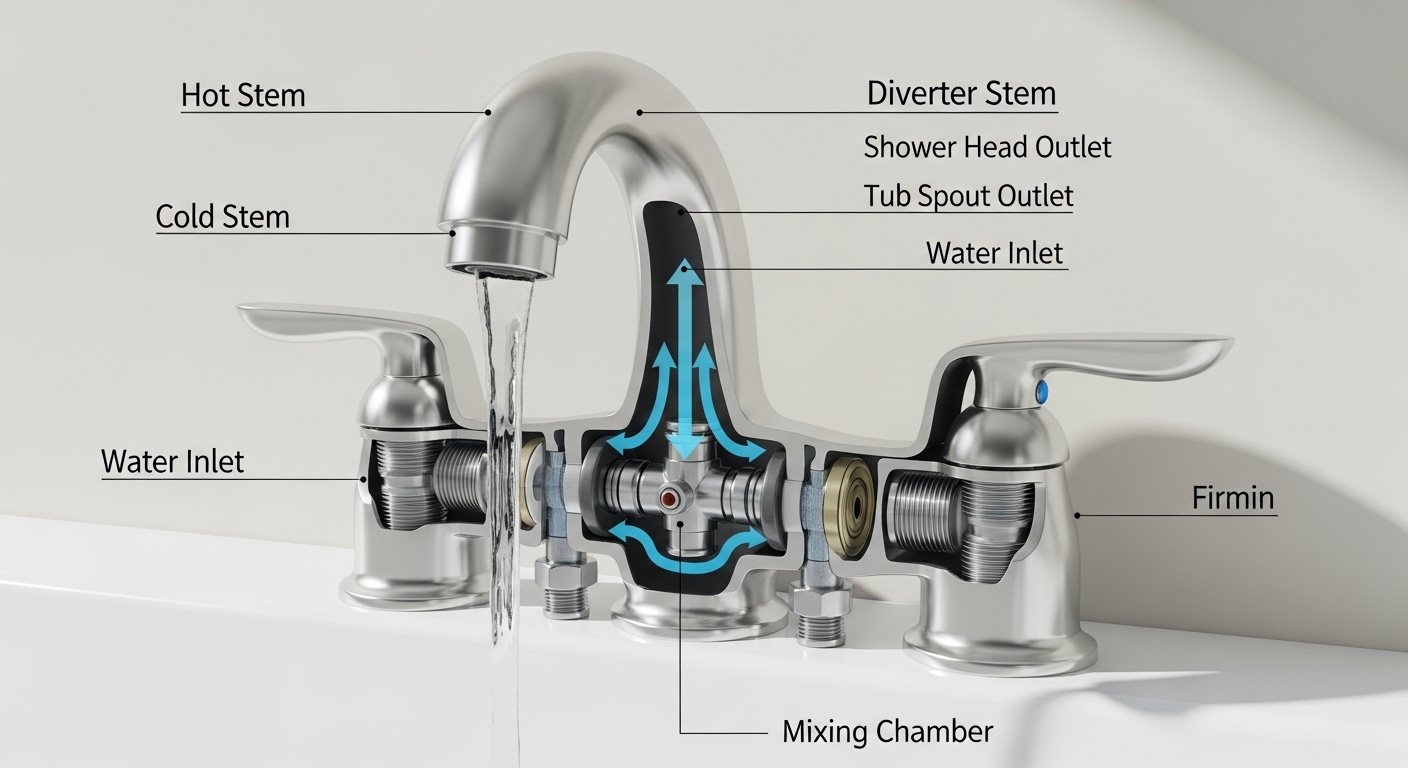
An adapter changes the connection (thread type or size), a diverter changes the direction (which outlet the water goes to), and “attachment” is the umbrella word for both plus everything else that bolts on. People use the terms interchangeably, which is why buying the wrong part is so common.
| Part | Its one job | Buy it when… |
|---|---|---|
| Adapter | Convert one thread/size to another | Your hose won’t thread onto your spout or arm |
| Diverter | Route water between tub, head, and handheld | You want to switch between two outlets |
| Attachment (kit) | Add a whole new function | You want a handheld, filter, or extra head |
The single most common mistake is buying a handheld kit and discovering the connector doesn’t fit your spout — that’s an adapter problem, not a kit problem. Before you order anything, learn the thread sizes involved. Our explainers on the bathtub faucet adapter and the more general faucet adapter head show you exactly how to identify male vs. female threads and standard sizes (like 1/2″ IPS and 15/16″-27) so the parts actually mate on the first try.
Why does my new diverter attachment leak or not switch properly?
A leaking or non-switching diverter is almost always one of three things: missing plumber’s tape on the threads, a worn or misseated rubber washer, or mineral grit stuck in the diverter gate. Wrap threads with 3–4 turns of PTFE tape, make sure the washer sits flat, and flush the line before installing. If a diverter that worked yesterday suddenly won’t send water upward, the internal gate has likely failed — our guide on a new diverter valve not working covers the fixes in order from easiest to hardest.
How much should a shower faucet attachment cost in 2026?
Expect to pay $20–$60 for a basic diverter or adapter, $30–$120 for a full handheld shower kit, and $15–$45 for a filter or high-pressure head. Anything over about $150 is usually a full shower system, not an attachment. Price tracks materials and warranty far more than brand name.
What actually moves the price:
- Brass vs. plastic internals — solid-brass diverters and adapters last years longer and resist cross-threading. Worth the extra $10–$15.
- Hose material — stainless-steel double-lock hoses outlast PVC and don’t kink or crack.
- Spray modes — a single-spray handheld is cheaper than a 5–7 mode wand with a massage setting.
- Finish — matte black and brushed gold usually cost a few dollars more than chrome and can show water spots differently.
- Warranty — a limited lifetime warranty signals the maker trusts the part; a 90-day warranty signals the opposite.
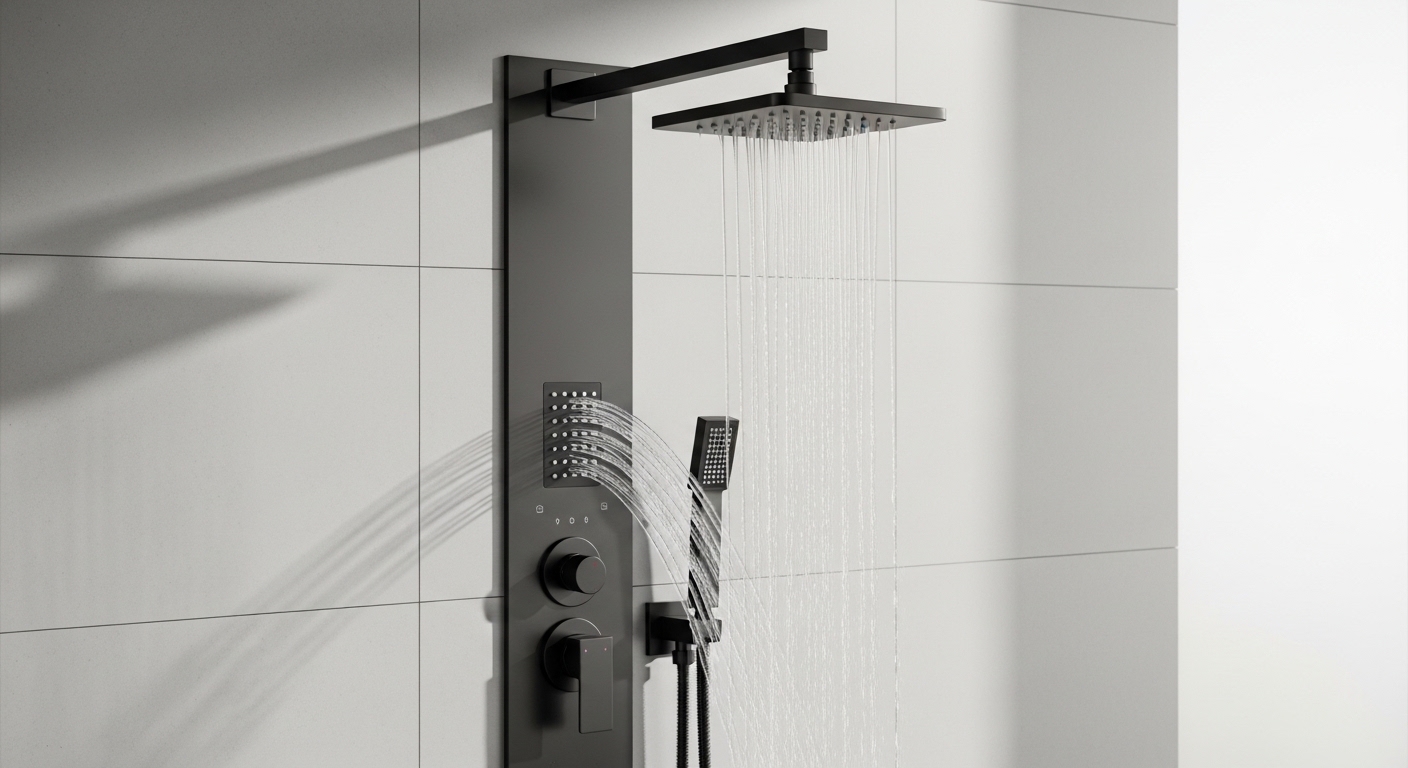
If a strong massage spray is what you’re after, it’s worth deciding whether you want that from a simple handheld attachment or a full multi-function setup — we compare the experience in is a shower system massage setup worth it, which helps you avoid overbuying.
How do I install a shower faucet attachment step by step?
To install most shower faucet attachments, remove the old spout or head, clean the threads, wrap them with plumber’s tape, hand-thread the new attachment, tighten gently, then test for leaks. Here’s the reliable sequence for a tub-spout diverter kit — the most common install:
- Identify your spout. Look underneath for a set screw. Set screw = slip-fit; no screw = threaded.
- Remove the old spout. Loosen the set screw and pull straight off, or twist the threaded spout counterclockwise.
- Clean and inspect the wall pipe. Wipe off old tape and check the nipple threads for damage.
- Wrap 3–4 turns of PTFE tape clockwise on the threads.
- Install the new diverter spout or adapter, hand-tight plus a gentle nudge — don’t overtighten and crack it.
- Mount the wall bracket and connect the hose and handheld, checking each rubber washer is seated.
- Run water and check every joint. Fix any weep with more tape, not more force.
That’s genuinely the whole job. If you can change a garden hose, you can do this.
Are cheap shower faucet attachments safe and reliable?
Quality attachments are safe and reliable; the risk with ultra-cheap ones is lead content, cracking plastic, and washers that fail in months. The safeguard is simple — buy attachments that meet recognized plumbing standards. In North America, look for compliance with NSF/ANSI 61 and 372 (lead-free) and, for whole fixtures, ASME A112.18.1 / CSA B125.1. These aren’t marketing badges; they’re the same standards inspectors reference. A brass, lead-free part with a real warranty from an established faucet maker is dramatically safer than an unbranded $8 part with no documentation.
FAQ
Can I put a shower head on a tub faucet without any threads?
Yes. Use a clamp-on tub spout diverter with a rubber gasket that grips a smooth spout, or replace the spout entirely with a slip-fit diverter spout sized to your wall pipe. Both let you run a hose to a shower head without threads on the original spout.
Will a shower faucet attachment lower my water pressure?
A well-made attachment barely affects pressure, but any long, thin diverter hose adds a little resistance, so a wall-mounted head fed by a spout diverter will feel softer than a proper overhead shower. High-pressure attachment heads counteract this by concentrating the spray. If pressure was already weak, fix the underlying cause first.
What size are most shower and tub attachment threads?
Shower arms and heads almost universally use 1/2″ NPT (about 15/16″ diameter). Tub spout wall pipes are usually 1/2″ IPS threaded or 1/2″/3/4″ copper slip-fit. Handheld hoses commonly use a 1/2″ connection with a cone washer. When in doubt, take the old part to the store or measure the outside thread diameter.
Do handheld shower attachments come with their own diverter?
Many do. Kits that mount to an existing shower arm usually include a three-way diverter so you can switch between the fixed head and the handheld. Kits that mount to a tub spout include the diverter built into the spout. Always confirm the kit lists a diverter if you want to keep both outlets.
Can renters install a shower faucet attachment without damaging anything?
Yes — attachments are renter-friendly because they thread or clamp on and reverse without a trace. Keep the original spout or head in a bag, use only hand tools, and swap the factory part back when you move out. No wall work, no permanent changes, deposit safe.
How long do shower faucet attachments last?
A quality brass diverter or adapter lasts 5–10+ years; rubber washers and inline filter cartridges are wear items you’ll replace every 6 months to a couple of years. Hard water shortens everything, so periodic vinegar cleaning meaningfully extends the life of any attachment.
The bottom line
A shower faucet attachment is the highest-value, lowest-effort upgrade in most bathrooms: for the price of a takeout dinner you can add a shower to a tub, drop in a handheld, filter your water, or make a weak stream feel strong — usually in under 20 minutes with no plumber. Match the attachment to your spout type, insist on lead-free brass and a real warranty, and wrap your threads. Do that, and it just works.
Author note: This guide was written by the WOWOW Faucet product team, who design, pressure-test, and warranty tub and shower fixtures for everyday North American plumbing. Every WOWOW attachment referenced is built to lead-free NSF/ANSI 372 material standards and backed by our limited lifetime warranty on manufacturing defects. We test diverters and hoses through thousands of on/off cycles before they ship, because the cheapest way to earn a repeat customer is a part that doesn’t leak on day 30.