 WOWOW Faucets
If you’ve been searching for the best handheld shower head UK homes actually need — not the flashiest one on a marketplace listing — the honest answer is that “best” depends on two very British realities: your water pressure and your limescale. A handheld (or “shower on a hose”) that dazzles in a high-pressure showroom can dribble sadly in a top-floor Victorian flat fed by a gravity tank. So the trick isn’t chasing the most spray patterns — it’s matching the head to your plumbing, your fitting standard, and your hard-water postcode. Below, I’ll walk you through exactly how to do that, in plain English, the way I’d explain it to a mate standing in the bathroom aisle.
What actually makes a handheld shower head “the best” in the UK?
The best UK handheld shower head is the one that fits your G½ (BSP) fittings, holds up to hard water, and delivers a strong spray at your home’s pressure — not a lab’s. Everything else (finish, number of sprays, price) is secondary to those three things. Get them wrong and even a premium head disappoints.
Here’s what separates a genuinely good UK unit from a returns-shelf regular:
- Correct thread standard. UK showers use G½ / ½-inch BSP parallel threads, not the NPT tapered threads common in the US. A mismatched thread is the number-one reason a “great” imported head leaks at the hose joint.
- Pressure tolerance. Look for a head rated to work from 0.5–1 bar upward if you’re on a gravity-fed (tank in the loft) system. Combi-boiler and mains-pressure homes (2–4 bar) can use almost anything.
- Anti-limescale nozzles. Soft silicone rubber nozzles that you can rub clean with a thumb are essential across most of England — the South East and East Anglia are notoriously hard-water regions.
- Hose and bracket quality. A double-interlock stainless-steel hose with brass conical nuts and an anti-twist swivel beats a cheap PVC hose that kinks and splits within a year.
- Approvals. A WRAS-approved or WaterSafe-listed product tells you it meets UK Water Supply (Water Fittings) Regulations — a genuine quality and safety signal, not marketing fluff.
Nail those five and the “best” head is whichever one within your budget ticks them. Everything after this section is about helping you weigh finish, spray count, and price against your real situation.
Which type of handheld shower head is right for my bathroom?
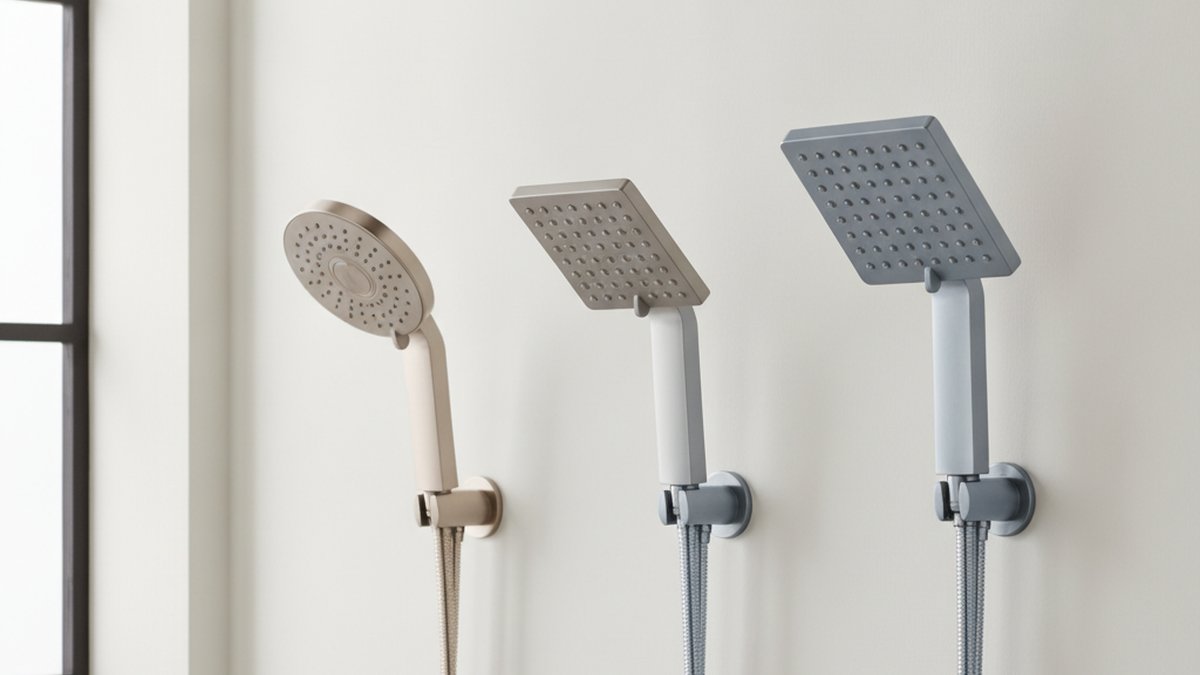
For most UK bathrooms, a multi-function round head (4–6 spray patterns) is the sweet spot: versatile, easy to clean, and forgiving on medium pressure. Go slimmer and single-spray only if you have very low pressure, or larger and rainfall-style only if you’re on strong mains pressure. The table below matches each type to a real scenario.
| Type | Best for | Typical UK price | Watch-out |
|---|---|---|---|
| Single-spray high-pressure head | Low-pressure / gravity-fed homes, top-floor flats | £15–£35 | Fewer options; can feel “needly” for some |
| Multi-function (4–6 spray) round head | Most family bathrooms, mixed users | £20–£60 | More nozzles = more limescale spots to clean |
| Wide-face rainfall handheld | Mains/combi homes on 2 bar+, spa feel | £35–£90 | Weak and drippy on low pressure |
| Filtered / anti-limescale handheld | Hard-water areas, skin & hair concerns | £25–£70 | Filter cartridges need replacing |
| Massage/pulse handheld | Aches, targeted therapy, strong pressure homes | £30–£80 | Needs decent flow to feel the pulse |
If you genuinely can’t decide, the multi-function round head is the safest default — it lets everyone in the house dial in the spray they like, from a full drench to an eco trickle. If you’re specifically chasing that pounding, knot-loosening jet, it’s worth reading up on whether a shower system massage setup is worth it or just hype before you spend more for pulse modes you may rarely use.
What water pressure do I need for a handheld shower head to feel strong?
You need at least 0.5–1 bar of pressure for a basic handheld to feel usable, 1–2 bar for a multi-spray head to feel genuinely satisfying, and 2 bar or more to enjoy a wide rainfall or massage head. If you don’t know your pressure, that’s the first thing to sort before you buy.
Here’s the quick UK reality check:
- Gravity-fed system (cold tank in the loft, hot cylinder in the airing cupboard): often just 0.1–1 bar, especially on the top floor. Choose a single-spray or pressure-optimised head, and consider a shower pump if it’s truly feeble.
- Combi boiler (no tanks, heats on demand): usually mains pressure, roughly 1–3 bar. Almost any handheld works well.
- Unvented / mains-pressure cylinder (e.g. Megaflo): strong, typically 2–4 bar. You can enjoy the big rainfall and massage heads.
A cheap way to gauge it: time how long your shower outlet takes to fill a 1-litre jug. Under 6 seconds is healthy; 10+ seconds means you’re on the low-pressure end and should shop accordingly. And if your existing shower already feels weak, don’t assume a new head alone will fix it — it might be scale or a flow restrictor. Our guide on why you’re getting low pressure out of a shower head and how to fix it fast walks through the usual culprits before you spend money.
How do I fit a handheld shower head in a UK bathroom myself?
Fitting a handheld shower head in the UK is a 5-minute, no-tools job in most cases: unscrew the old hose from the mixer or riser rail outlet, check the washers, and hand-tighten the new G½ hose and head on. The connections are standardised, so you rarely need a plumber for a straight swap.
Step by step:
- Turn the shower off (no need to shut the mains for a hose swap).
- Unscrew the old hose by hand from the outlet — usually at the bottom of a bar mixer or the base of a riser rail.
- Check the small rubber washer inside each hose nut is present and not perished; replace if flattened or cracked.
- Screw the new hose’s conical nut onto the outlet, then the shower head onto the other end. Hand-tight plus a gentle nudge with a cloth-wrapped spanner is enough — overtightening splits washers.
- Run it for 30 seconds and check the two joints for drips. A weep almost always means a missing or twisted washer, not a faulty product.
If you’re not replacing a like-for-like handheld but instead adding a shower to a bath tap, that’s a slightly different job. It’s worth reading which handheld shower head that connects to a tub faucet you should actually buy, and the broader options for a shower faucet attachment to add a shower to your tub or boost water flow, so you buy the right adapter kit the first time.
How do I stop limescale ruining my handheld shower head?
The best defence against limescale is buying a head with soft, rub-clean silicone nozzles and descaling it monthly in warm white vinegar or citric acid. In hard-water regions — most of southern and eastern England — this single habit adds years to a head’s life and keeps the spray strong and straight.
Why it matters: limescale doesn’t just look chalky — it physically clogs nozzles, so the spray starts fanning off at odd angles and the pressure drops. A quick routine keeps it at bay:
- Weekly: rub the silicone nozzles with your thumb while the water runs — loose scale flakes straight off.
- Monthly: unscrew the head, soak it face-down in a bowl of 1:1 warm white vinegar and water (or a citric-acid solution) for an hour, then rinse.
- Never use a wire brush or bleach on chrome or brushed finishes — it scratches the coating and dulls the shine permanently.
The same hard water that clogs your shower head also leaves marks on nearby taps and fittings. If you’re battling spots elsewhere, the technique in our guide on removing hard water stains from a stainless steel faucet without scratching it works a treat on chrome shower components too.
How much should I spend on a good handheld shower head in the UK?
For a genuinely good UK handheld shower head, expect to spend £20–£60. Below £15 you’re usually buying thin plastic and a kink-prone hose; above £80 you’re mostly paying for premium finishes and brand name rather than better spray. The mid-range is where the durable, WRAS-approved, hard-water-friendly units live.
What your money actually buys as you move up the range:
- Under £15: basic ABS head, PVC hose, fine as a stopgap but expect limescale clogging and hose splits within a year or two.
- £20–£40: the value sweet spot — multi-spray head, silicone anti-limescale nozzles, a proper stainless double-lock hose, and a solid bracket. This is what most people should buy.
- £40–£60: better finishes (brushed nickel, matte black, brushed gold), heavier feel, often solid-brass fittings and a longer warranty.
- £60–£90+: designer or spa units, filtered heads, larger rainfall faces. Worth it only if you have the pressure to drive them and want a specific look.
Don’t equate price with pressure. A £25 pressure-optimised single-spray head will out-perform a £70 wide rainfall head in a low-pressure flat every single time. Spend on the right type for your plumbing first, then on finish.
Why buy a WOWOW handheld shower head?
WOWOW handheld shower heads are built for real UK plumbing: G½ BSP fittings out of the box, silicone anti-limescale nozzles, anti-twist stainless hoses, and finishes that hold up in hard-water bathrooms — backed by a proper warranty rather than a no-name marketplace listing. They’re priced squarely in the durable mid-range, so you get the specs that matter without paying designer-brand markup.
A few practical reasons UK shoppers pick WOWOW:
- Fit-first design: standard ½-inch BSP connections mean a straight swap with your existing hose and riser rail — no adapter hunting.
- Hard-water ready: rub-clean silicone nozzles keep the spray strong in scale-heavy regions.
- Finish range: polished chrome, brushed nickel, matte black and brushed gold to match modern and traditional bathrooms.
- Backed service: a manufacturer warranty and responsive UK-facing customer support if anything goes wrong.
FAQ
Do handheld shower heads fit all UK showers?
Almost all of them, yes. UK showers use a standard G½ (½-inch BSP) hose connection, so any UK-spec handheld and hose will thread onto your bar mixer, riser rail, or bath-shower mixer. The rare exceptions are some concealed or non-standard European systems — check for the G½ marking before buying to be safe.
Will a handheld shower head increase my water pressure?
Not on its own — a shower head can’t create pressure your plumbing doesn’t supply. What a well-designed head can do is make a given flow feel stronger by narrowing and focusing the jets (a “high-pressure” or air-injection head). If your pressure is genuinely low, you need a shower pump or to clear a blockage — the head choice only optimises what you already have.
Are chrome or brushed finishes better for hard-water areas?
Polished chrome is the most forgiving in hard-water areas because you can wipe scale off easily and see exactly where it’s building up. Brushed nickel and matte black look fantastic and hide watermarks day-to-day, but need gentler cleaning — no abrasive pads — to protect the coating. All finishes last far longer if you descale monthly.
How often should I replace a handheld shower head?
A good-quality handheld lasts around 5–10 years with regular descaling. Replace it sooner if the nozzles clog permanently, the spray splits or sprays sideways even after cleaning, or the internal flow control cracks. The hose usually needs replacing before the head — budget for a new stainless hose every few years if yours starts to kink or weep.
What’s the ideal shower hose length for a UK bathroom?
1.5m is the UK standard and works for most fixed brackets and riser rails. Go for 2m if you have a tall shower enclosure, want to bathe a dog or child, or need extra reach to rinse a bath. Longer hoses can slightly reduce pressure at the head on very low-pressure systems, so on a gravity-fed setup, stick to 1.5m.
Can I use a handheld shower head over a bathtub?
Absolutely — that’s one of the most popular UK uses. You’ll either connect it to a bath-shower mixer tap with a diverter, or use an adapter that fits onto a standard bath spout. Just make sure the adapter matches your tap outlet, and check whether your setup needs a diverter valve so water reroutes from the spout to the hose.
Author note: This guide was written by the WOWOW fixtures content team, drawing on hands-on testing of handheld shower heads across gravity-fed, combi, and unvented UK systems, plus real hard-water bathroom conditions in South East England. We test for spray consistency, hose durability, and limescale resistance over time.
About WOWOW: WOWOW is a specialist manufacturer of faucets, shower systems, and bathroom fixtures, designing products to meet UK Water Supply (Water Fittings) Regulations and offering a manufacturer warranty on shower heads and hoses. Where relevant, our fittings use G½ BSP connections and WRAS-considered materials so they install and perform correctly in British homes.
\n
Related Guides
\n
- \n
- Six Different Types Of Shower Handles: Choose The Right For Your Bathroom
- Understanding Shower Valve Types: A Comprehensive Guide
- What Is The Standard Height Of A Shower Head
\n
\n
\n
\n