 WOWOW Faucets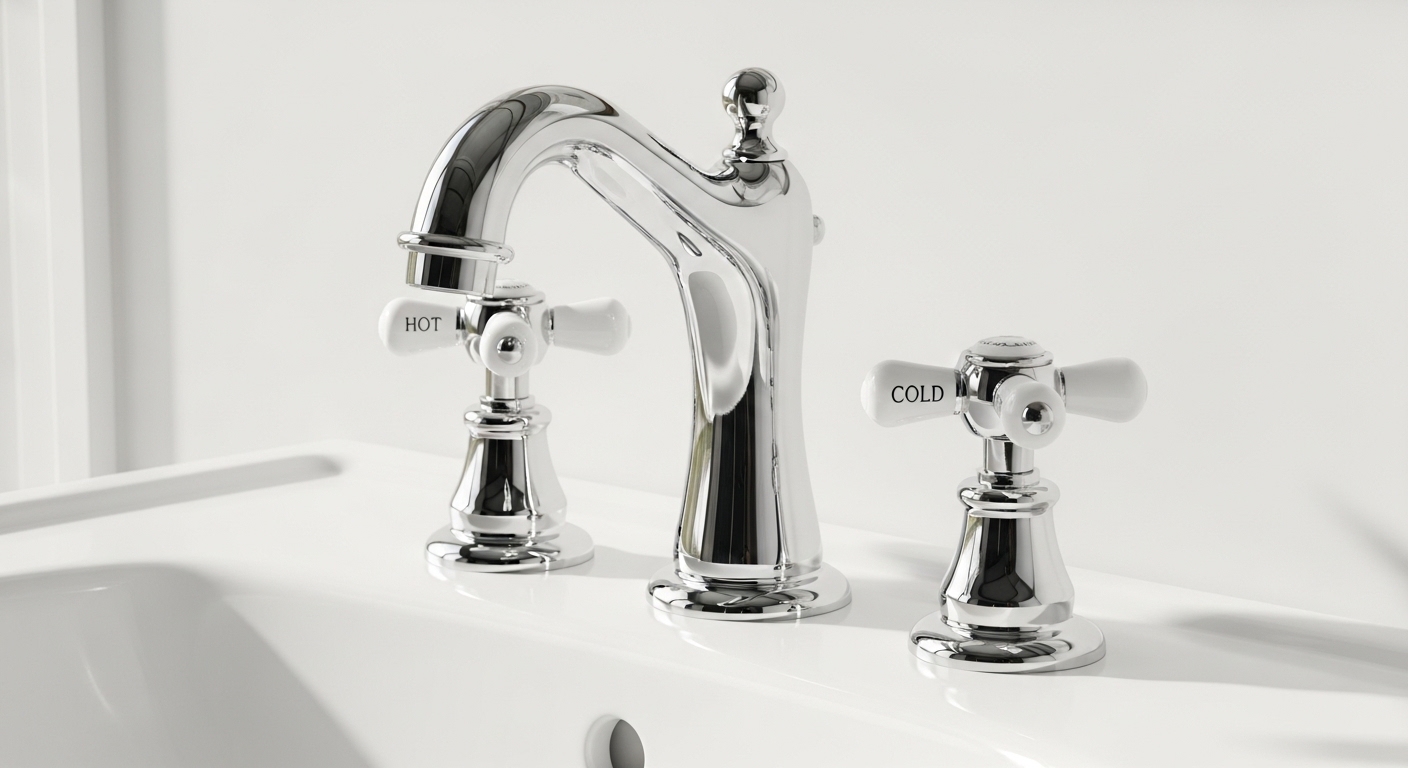
If you’re shopping for a victorian centerset faucet, you’re usually trying to solve two things at once: you want the ornate, old-world look of a traditional bathroom, and you need it to physically fit a standard 4-inch, three-hole sink without a plumbing project. The good news is that “centerset” and “Victorian” together describe exactly that — a period-styled faucet where the spout and both handles are mounted on a single base plate spaced 4 inches apart. Below, I’ll walk you through how to know if it fits, what finishes hold up, what you should pay, and how it stacks up against the widespread (8″) and single-hole alternatives — the way I’d explain it to a friend standing in the plumbing aisle.
What exactly makes a faucet “Victorian centerset” — and how is it different from widespread?
“Victorian centerset” is really two words doing two jobs. “Centerset” tells you the plumbing configuration: the faucet fits a sink with three holes drilled 4 inches apart (center to center), and everything — spout plus both handles — sits on one connected deck plate. “Victorian” tells you the styling: ornamental curves, teapot-style or gooseneck spouts, and cross-top or porcelain lever handles that echo late-1800s design.
The confusion almost always comes from mixing up centerset and widespread. They look similar in photos but they are not interchangeable:
- Centerset: 4″ hole spacing, handles and spout on one base plate, sold as a single unit. Easiest to install.
- Widespread: 8″–16″ adjustable spacing, three separate pieces (spout and two handles) with no connecting plate. More flexible, more upscale, harder to install.
- Single-hole: one hole, one handle or two mounted on a base — increasingly common in modern baths but rarely styled as Victorian.
So a Victorian centerset faucet gives you the formal, decorative look people associate with widespread traditional faucets, but in a compact, beginner-friendly package that drops onto the sink most American homes already have.
Will a Victorian centerset faucet fit my sink? How do I measure the holes?
It fits if your sink has three holes and the outer two are 4 inches apart, center to center — that’s the quick answer. Grab a tape measure, find the two outer holes (the handle holes), and measure from the middle of one to the middle of the other. If it reads right around 4 inches, a centerset faucet is your match. If it reads 8 inches or more, you need a widespread. If there’s only one hole, you need a single-hole faucet.
A few things people miss:
- Measure center-to-center, not edge-to-edge. Edge measurements will throw you off by half an inch or more.
- Check the deck depth. Some ornate Victorian base plates are longer front-to-back; make sure your sink deck has room behind the holes.
- Confirm the drain type. Most bathroom centerset faucets include a pop-up drain assembly — nice, but check that your sink is drilled for one.
- Look under the counter. You want at least a few inches of clearance for the supply lines and mounting nuts.
If your sink is drilled for 8″ widespread and you’ve fallen in love with a centerset, don’t force it — you’d leave gaps. The reverse trick (using a centerset on a single-hole sink) sometimes works because many centerset faucets ship with a deck plate that covers a single hole, but always read the spec sheet first. When you do get to the install itself, the general process mirrors any standard swap — our step-by-step on how to replace a bathroom faucet walks through shutting off supplies, clearing the old unit, and seating the new one.
Which finish should I pick — oil-rubbed bronze, chrome, or brushed nickel?
For a Victorian look, oil-rubbed bronze and polished chrome are the two most authentic choices — bronze for a warm, aged, period-correct feel and chrome for a bright, formal, easy-to-clean look. Brushed nickel is a solid modern-traditional compromise that hides water spots better than either. The “right” one depends on your hardware, your water, and how much cleaning you want to do.
Here’s how the common finishes actually behave day to day:
| Finish | Victorian authenticity | Hides water spots & fingerprints | Best for |
|---|---|---|---|
| Oil-rubbed bronze | Very high — warm, aged look | Excellent | Traditional, farmhouse, warm-toned baths |
| Polished chrome | High — bright and formal | Poor (spots show fast) | Classic white or marble baths |
| Brushed nickel | Medium — softer, modern-traditional | Good | Everyday family bathrooms |
| Polished/brushed brass or gold | High — opulent, ornate | Good | Statement powder rooms |
One real-world tip: if you have hard water, chrome will show mineral spotting almost daily, while oil-rubbed bronze and brushed nickel are much more forgiving. Bronze is a “living finish” on some faucets — meaning it develops highlights over time as hands touch it — which many people love but a few dislike. If you want to keep any finish looking new, the same gentle no-scratch cleaning approach we cover for removing hard water stains without scratching applies to Victorian finishes too: mild soap, soft cloth, and no abrasive pads. If you’re weighing a bronze traditional faucet specifically, it’s worth reading our comparison of an oil-rubbed bronze bathroom faucet from Moen versus WOWOW before you commit.
How much should a Victorian centerset faucet cost in 2026?
Expect to pay roughly $60 to $250 for a Victorian centerset bathroom faucet, with the sweet spot for a well-built brass-body unit landing around $90–$160. Below about $50 you’re usually looking at zinc-alloy bodies and plastic internals that won’t hold up; above $250 you’re paying for a premium designer brand name more than added function.
Here’s what your money is actually buying at each tier:
- $60–$90 (budget): Often zinc alloy or thin brass, decent finishes, ceramic-disc cartridges if you’re lucky. Fine for a guest bath used lightly.
- $90–$160 (mid-range — best value): Solid brass body, ceramic-disc valves rated for long life, real metal handles, included pop-up drain. This is where most buyers should shop.
- $160–$250 (premium): Heavier castings, designer detailing, better finish warranties, sometimes lifetime coverage.
The single biggest predictor of whether a faucet lasts is the cartridge and the body material. A solid-brass body with a ceramic-disc cartridge will outlast a zinc body with a rubber-washer valve by many years, and it’s the cartridge — not the pretty handles — that determines whether you get a drip in year two. If that ever happens, it’s usually a quick fix; our guide to fixing a leaky faucet cartridge handle shows how to swap one in under an hour.
Are two-handle Victorian faucets harder to use or maintain than single-handle?
Not really — two-handle faucets are just as easy to live with, and in some ways simpler to repair, because each side (hot and cold) has its own independent cartridge. The trade-off is that you use two hands to mix your temperature instead of nudging one lever, which some people find less convenient at a busy family sink but many find more precise and more elegant.
From a maintenance standpoint, two-handle designs have a hidden advantage: if only the hot side drips, you replace only the hot cartridge. On a single-handle faucet, one cartridge controls everything, so any valve failure means pulling the whole mechanism. Victorian faucets are almost always two-handle by design — the symmetry is part of the period look — so if you strongly prefer one-handle operation, a Victorian style probably isn’t your match.
Cross-handles versus lever handles is the other choice. Cross-handles (the classic “+” shape) are the most period-authentic and give great grip when wet; porcelain lever handles are gentler on arthritic hands and often carry hot/cold indicator buttons. Both are correct for a Victorian look — pick by whose hands will use the sink.
What should I check before I buy — a quick pre-purchase checklist
Before you click “add to cart,” run through this short list — it prevents the two most common returns (wrong hole spacing and wrong drain):
- Hole spacing: Confirm 4″ center-to-center, three holes.
- Body material: Look for “solid brass” in the specs, not just “metal.”
- Cartridge type: Ceramic disc beats rubber washer for longevity.
- Flow rate: Most U.S. bathroom faucets are capped at 1.2 GPM by federal and state rules — good for water savings, and plenty for handwashing.
- Drain included? Many centersets include a matching pop-up drain; confirm so finishes match.
- Certifications: Look for cUPC/NSF listing and lead-free compliance.
- Warranty: A finish-and-function warranty (ideally lifetime for residential) signals the maker trusts the build.
If you’re outfitting a whole traditional bathroom, it’s worth thinking about matching your other fixtures too — the same Victorian styling logic applies to tub and shower hardware, and coordinating finishes across the room is what makes the look feel intentional rather than accidental.
FAQ
Is a Victorian centerset faucet the same as a widespread faucet?
No. A Victorian centerset faucet has 4-inch hole spacing with the spout and handles on one connected base plate. A widespread faucet has 8″–16″ adjustable spacing with three separate pieces and no connecting plate. They fit different sinks and are not interchangeable — always measure your sink’s hole spacing first.
Can I put a centerset faucet on a single-hole sink?
Sometimes. Many centerset faucets ship with a base (deck) plate that can cover a single center hole, but you need to confirm the faucet’s mounting hardware supports it and that the single hole aligns with the spout. Check the product spec sheet before buying — not every centerset works as a single-hole install.
What’s the best finish for a Victorian bathroom faucet with hard water?
Oil-rubbed bronze and brushed nickel are best for hard water because they hide mineral spotting and fingerprints far better than polished chrome, which shows water spots almost daily. If you love the bright look of chrome, plan on wiping it down more often with a soft cloth and mild cleaner.
How long should a good Victorian centerset faucet last?
A solid-brass Victorian centerset faucet with a ceramic-disc cartridge should give 15–20+ years of service, and the cartridge itself is a cheap, replaceable part if it ever drips. Budget zinc-body faucets with rubber-washer valves often start leaking within a few years, which is why body material and cartridge type matter more than price alone.
Do Victorian centerset faucets come with a drain?
Many do — a matching metal pop-up drain assembly is commonly included so the drain finish matches the faucet. Not all of them include it, though, so read the listing carefully. If yours doesn’t include one, buy a drain in the same finish so your sink looks coordinated.
Are two-handle Victorian faucets less water-efficient?
No. Water efficiency is set by the aerator and flow rate, not the number of handles. Most modern U.S. bathroom faucets — Victorian or otherwise — are limited to about 1.2 GPM regardless of whether they have one handle or two, so a two-handle Victorian faucet uses the same water as a single-handle modern one.
The bottom line
A Victorian centerset faucet is the easiest way to get a genuinely traditional, ornate bathroom look on the standard 4-inch sink most homes already have — no re-drilling, no plumbing project, and a friendly $90–$160 sweet spot for a solid-brass, ceramic-disc unit that will last decades. Measure your hole spacing, choose a forgiving finish if you have hard water, confirm the cartridge and certifications, and you’ll end up with a fixture that looks period-correct and performs like a modern one.
Author note: This guide was written by the WOWOW Faucet product content team, who spend their days hands-on with bathroom and kitchen faucets — measuring hole spacing, testing cartridges, and comparing finishes across brands. WOWOW manufactures and sells faucets direct to homeowners, and our fixtures are built with lead-free, cUPC-listed components and backed by our warranty program. We test finishes and valves against industry durability standards so the advice above reflects how these faucets actually behave in real bathrooms, not just on a spec sheet.
\n
Related Guides
\n
- \n
- What are The Different Types of Bathroom Faucets
- What is The Standard Size Hole for A Kitchen or Bathroom Faucet
- Best White Kitchen Faucets – Buying Guide & Reviews
\n
\n
\n
\n