 WOWOW Faucets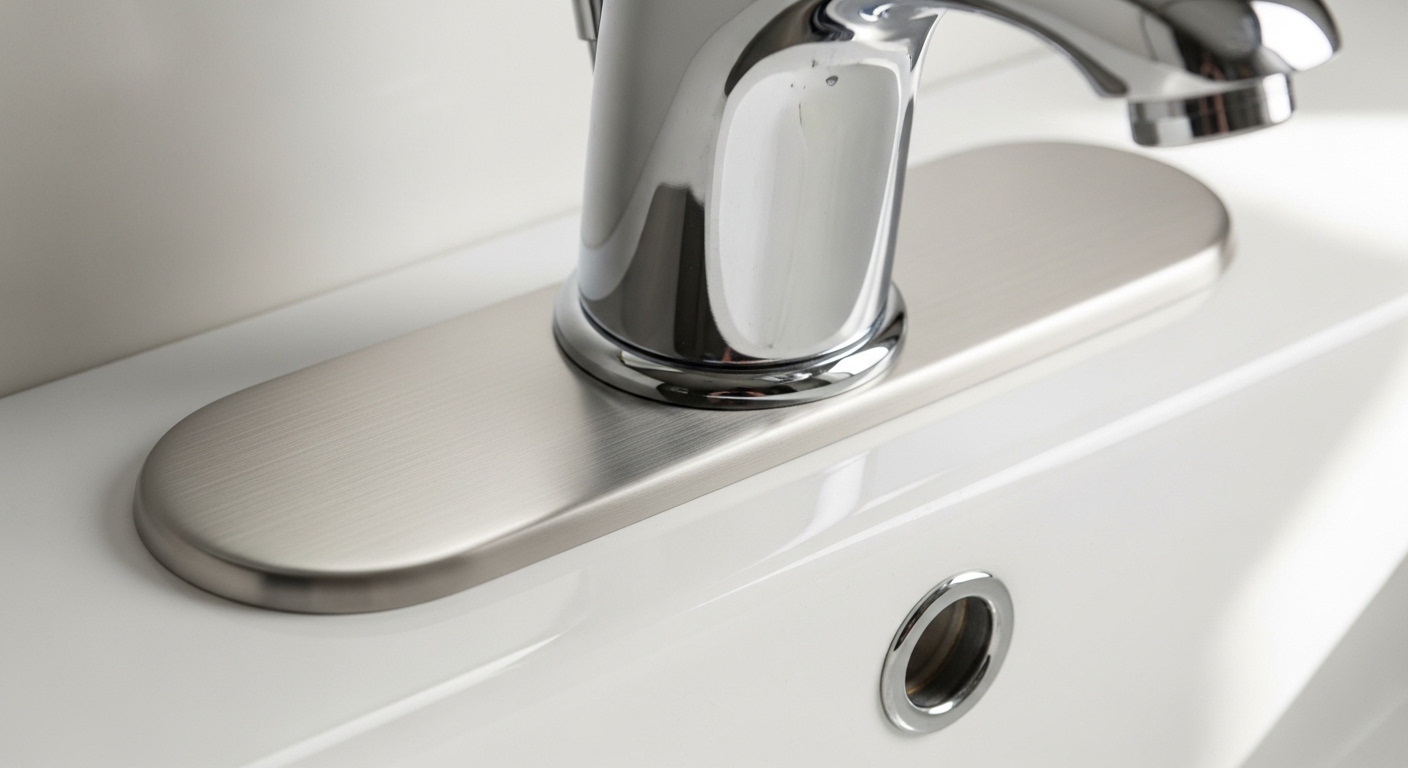
If you’re shopping for a moen faucet escutcheon plate, you’re almost always solving one of two problems: you have leftover holes in your sink or countertop that need hiding, or your old plate is corroded, loose, or no longer matches your refreshed bathroom. Both are easy, inexpensive fixes — but buying the wrong size, finish, or mounting style is the single most common way people end up with a wobbly faucet or a plate that doesn’t seal against the deck. This guide walks you through exactly what the plate does, how to pick the right one, and when you genuinely need it versus when you’re better off skipping it.
We sell and test faucets and replacement parts every day at WOWOW Faucet, so we’ll keep this practical: real measurements, real finishes, and the small details that decide whether your install looks clean or amateur.
What does an escutcheon plate actually do on a Moen faucet?
An escutcheon plate covers and conceals the mounting holes and plumbing connections beneath your faucet base. On a Moen faucet specifically, it’s the oval or rectangular plate the faucet body sits on, bridging the gap between a single-hole faucet and a sink drilled for three holes (the standard 4-inch centerset or 8-inch widespread spacing).
Beyond hiding holes, it does three quiet but important jobs:
- Seals out water. The plate, paired with a rubber or foam gasket, keeps splash water from running down into the cabinet and rotting the deck around your mounting holes.
- Stabilizes the faucet. A properly clamped deck plate adds rigidity, so the faucet doesn’t rock when you push the handle.
- Hides cosmetic damage. Years of an old faucet leave mineral rings, sealant residue, and discoloration. A fresh plate covers all of it.
One thing it does not do: it isn’t structural in the way the mounting nut is. The escutcheon plate is a finish piece. If your faucet feels loose, the plate isn’t the fix — the under-deck mounting hardware is. (If your faucet base is also stained or crusty before you cover it, it’s worth a quick clean first — our faucet base cleaning guide covers removing limescale and buildup so the new plate seats flat.)
How do I know if my sink needs an escutcheon plate or not?
Count the holes in your sink and compare them to your faucet. If your sink has more holes than your faucet uses, you need an escutcheon plate (or hole covers). If the holes match exactly, you don’t.
Here’s the quick decision logic:
- 3-hole sink + single-hole faucet → You need a deck plate to cover the two outer holes. This is the most common scenario.
- 1-hole sink + single-hole faucet → No plate needed. Most single-hole Moen faucets ship with an optional escutcheon you can use or leave off.
- 3-hole sink + widespread (3-piece) faucet → No deck plate; each piece has its own small base trim.
- Replacing an old centerset → Match the new faucet’s plate to the old 4-inch hole spacing, or you’ll expose holes.
The measurement that matters most is hole spacing — the distance center-to-center between the outer holes. A 4-inch spread is “centerset,” an 8-inch spread is “widespread.” Measure before you buy. A Moen escutcheon designed for 4-inch centers will not cover an 8-inch sink, and vice versa.
What size and shape Moen escutcheon plate do I need?
For a standard bathroom faucet, you want a plate that’s at least as wide as your hole spacing plus the hole diameter — typically around 10 inches long for a 4-inch centerset, and 12+ inches for widespread. Always confirm the plate’s listed length and the faucet model it’s designed for before buying.
Moen escutcheon plates aren’t fully universal. They’re grouped by faucet family and spacing, so the safest path is to match by your faucet’s model number. Here’s how the common types break down:
| Plate type | Fits this hole setup | Typical length | Best for |
|---|---|---|---|
| Centerset deck plate | 3 holes, 4 in. on center | ~10 in. | Single-hole faucet on a standard 3-hole bathroom sink |
| Widespread deck plate | 3 holes, 8 in. on center | ~12 in. | Converting a widespread sink to a single-hole faucet |
| Kitchen escutcheon | 4 holes, varies | ~10–12 in. | Covering soap-dispenser or sprayer holes you no longer use |
| Round base trim | 1 hole | 2–3 in. dia. | Cosmetic ring around the base of a single-hole faucet |
If you’re unsure of your exact Moen part, find the model number stamped under the spout or printed on your original paperwork, then cross-reference it. Brand-specific parts catalogs make this painless — the same way we walk people through matching parts in our Kohler replacement parts catalog guide, the principle applies to Moen: match the part to the model, never guess by eyeballing the shape.
What finish should I choose so the plate matches my faucet?
Match the escutcheon plate finish to your faucet exactly — chrome to chrome, brushed nickel to brushed nickel, matte black to matte black. A mismatched plate is the most obvious tell of a budget or rushed install, because it sits right at eye level.
Moen’s most common finishes are Chrome, Spot Resist Brushed Nickel, Matte Black, and Mediterranean/Oil-Rubbed Bronze. The tricky part isn’t the color name — it’s that finishes from different production batches or brands can look subtly off. A third-party “brushed nickel” plate may read slightly warmer or cooler than Moen’s. When in doubt, buy the genuine Moen plate for that faucet line.
Finish also affects durability and cleaning. Physical Vapor Deposition (PVD) finishes resist scratching and tarnish far better than electroplated ones, which matters on a plate that gets splashed and wiped constantly. If you want to understand why two “same-color” plates can age completely differently, our breakdown of faucet coating types compared explains which finishes hold up and which one to avoid in a hard-water bathroom.
A quick finish-matching checklist:
- Confirm the exact finish name on your faucet — not just “silver” or “black.”
- Buy plate and faucet from the same line where possible.
- For brushed finishes, check the grain direction looks consistent in photos.
- If reusing an old faucet with a new plate, hold them side by side in daylight before committing.
How do I install a Moen escutcheon plate myself?
You can install a Moen escutcheon plate in about 15–20 minutes with no special tools — usually just a basin wrench and a clean rag. The plate goes on before the faucet body is tightened down, sandwiching its gasket against the sink deck.
Here’s the basic sequence:
- Shut off the water. Close both supply valves under the sink and open the faucet to release pressure.
- Clean the deck. Wipe away old caulk, mineral rings, and debris so the new gasket seats flat. A bumpy deck causes leaks and rocking.
- Place the gasket, then the plate. Most Moen plates use a dedicated rubber or foam gasket underneath. Center it over the holes.
- Set the faucet onto the plate. Feed the supply lines and mounting shank through the center hole.
- Tighten from below. Thread the mounting nut up the shank and snug it by hand, then a final turn with the basin wrench. Don’t overtighten — you can crack a thin plate or distort the gasket.
- Apply a thin bead of silicone around the plate’s outer edge if your model calls for it, and wipe the excess.
- Turn the water back on and check for drips at the supply connections and around the base.
If you’re doing a full faucet swap at the same time, the plate step folds right into the larger job — our complete kitchen faucet installation guide shows the deck-plate-and-gasket sequence in context, and the same approach applies to a bathroom faucet.
Why is water getting under my escutcheon plate — and how do I stop it?
Water under the plate almost always means the gasket isn’t sealing or the silicone bead has failed. The fix is to remove the plate, replace or reseat the gasket, and lay a fresh thin bead of silicone around the perimeter so splash water can’t migrate underneath.
Common causes, in order of likelihood:
- Old, hardened gasket. Rubber shrinks and stiffens over years. A $3 replacement gasket fixes most leaks.
- Uneven deck. Leftover caulk ridges or limescale keep the plate from sitting flat.
- No silicone seal. Some installs skip the perimeter bead; without it, pooled water wicks under the edge.
- Loose mounting nut. If the faucet rocks, the plate lifts on one side with each push of the handle.
Don’t ignore standing water around the base — over time it seeps through the holes and damages the cabinet below. If you’re chasing a leak that seems to come from the base rather than the spout or handle, it’s worth ruling out the connections too; our guide on why a new faucet still leaks covers the usual culprits beyond the escutcheon itself.
Should you buy a genuine Moen plate or a universal one?
Buy a genuine Moen escutcheon plate when finish-matching matters or your faucet is under warranty; choose a universal deck plate only when you simply need to cover holes and the faucet finish is a common color like chrome. Using a non-Moen part generally won’t void the faucet warranty by itself, but a poor-fitting plate can cause the leaks that lead to bigger problems.
Here’s the honest trade-off. Genuine Moen plates cost more but guarantee the exact finish, gasket fit, and hole geometry for your model. Universal plates are cheaper and widely available, and they’re perfectly fine for a chrome utility bathroom or a rental. Where universal plates get risky is on premium finishes — matte black and bronze tones vary a lot between manufacturers, so a “close enough” plate looks wrong next to the real faucet.
| Factor | Genuine Moen plate | Universal deck plate |
|---|---|---|
| Finish match | Exact | Good for chrome, risky for black/bronze |
| Price | Higher | Lower |
| Fit & gasket | Model-specific, sealed | Adjustable, may need extra sealant |
| Warranty peace of mind | Best | Usually fine, verify with maker |
| Availability | Through Moen / dealers | Widely stocked |
Materials matter here too. A solid brass plate resists corrosion and feels substantial; a cheap zinc-alloy plate can pit and flake in a humid bathroom. If you care about longevity, the same logic in our brass vs zinc faucets comparison applies directly to the plate you’re choosing.
How much should a Moen faucet escutcheon plate cost?
Expect to pay roughly $10–$35 for a genuine Moen escutcheon plate, and $8–$20 for a quality universal deck plate. Premium finishes like matte black or oil-rubbed bronze sit at the top of that range; basic chrome is the cheapest.
What you should not do is buy the absolute cheapest plate to save a few dollars. The plate is the part everyone sees and touches, and a thin stamped plate with a flimsy gasket is exactly what leads to the leaks and rocking we covered above. Spending an extra ten dollars on a solid plate with a proper gasket is the best value upgrade in the entire job.
FAQ
Is an escutcheon plate the same as a deck plate or base plate?
Yes — “escutcheon plate,” “deck plate,” and “base plate” all refer to the same thing on a faucet: the cover plate that hides mounting holes and connections under the faucet body. Moen uses “escutcheon” in its parts lists, while many retailers say “deck plate.” For shower valves, “escutcheon” instead refers to the round trim plate on the wall around the valve, so always note whether you’re talking about a sink or a shower.
Can I use a Moen escutcheon plate with a non-Moen faucet?
Sometimes, but it’s not guaranteed. The plate’s center hole and gasket are sized for Moen faucet shanks, so a different brand may not seat or seal correctly. If you have a non-Moen faucet, buy a universal deck plate or the plate made for your faucet’s brand instead — it’ll fit the shank diameter and gasket profile properly.
Do all Moen single-hole faucets come with an escutcheon plate?
Most do, but it’s usually optional. Moen ships many single-hole bathroom and kitchen faucets with a deck plate in the box so you can install on either a 1-hole or 3-hole sink. Check the product listing — if it says “optional deck plate included,” you can use it to cover three holes or leave it off for a clean single-hole look.
How do I clean and maintain my escutcheon plate?
Wipe it with a soft cloth and mild soap; for limescale, use a 50/50 white vinegar and water solution, then rinse and dry. Avoid abrasive pads and harsh chemicals, which scratch and dull the finish — especially on brushed nickel and matte black. Drying the plate after use prevents the water spots and mineral rings that build up fastest right at the base.
What if my new faucet’s plate doesn’t cover the old stain ring on my sink?
If a faded ring or scratch from the old faucet extends beyond your new plate, choose a slightly larger deck plate, or for a widespread sink pick a 12-inch plate instead of a 10-inch one. For deep mineral staining on the deck itself, clean it first — a fresh plate hides marks but won’t compress over crusty buildup, so the surface needs to be smooth for a proper seal.
Does adding an escutcheon plate help with a wobbly or loose faucet?
Not directly — a loose faucet is fixed by tightening the mounting nut underneath, not by adding a plate. That said, a properly clamped escutcheon plate with a firm gasket does add rigidity and reduces deck flex. If your faucet still rocks after tightening, the mounting hardware or a worn washer is the real issue, not the plate.
About the author: This guide was written by the WOWOW Faucet product team, who design, test, and sell kitchen and bathroom fixtures and replacement parts. We bench-test faucet bodies, plates, and gaskets for fit, finish durability, and leak resistance before recommending them.
Why trust WOWOW Faucet: WOWOW Faucet is a dedicated faucet and bathroom-fixture brand at www.wowowfaucet.com. Our faucets and components are built with corrosion-resistant materials, tested to standard residential water-pressure and durability cycles, and backed by a manufacturer’s warranty. We follow lead-free compliance standards (such as those aligned with NSF/ANSI and the U.S. Safe Drinking Water Act) so the parts that touch your water are safe as well as good-looking.
\n
Related Guides
\n
- \n
- What is An Escutcheon Plate on A Faucet?
- What is The Standard Size Hole for A Kitchen or Bathroom Faucet
- Is an Oil Rubbed Bronze Bathroom Faucet by Moen Worth It, or Should You Consider WOWOW Instead?
\n
\n
\n
\n