 WOWOW Faucets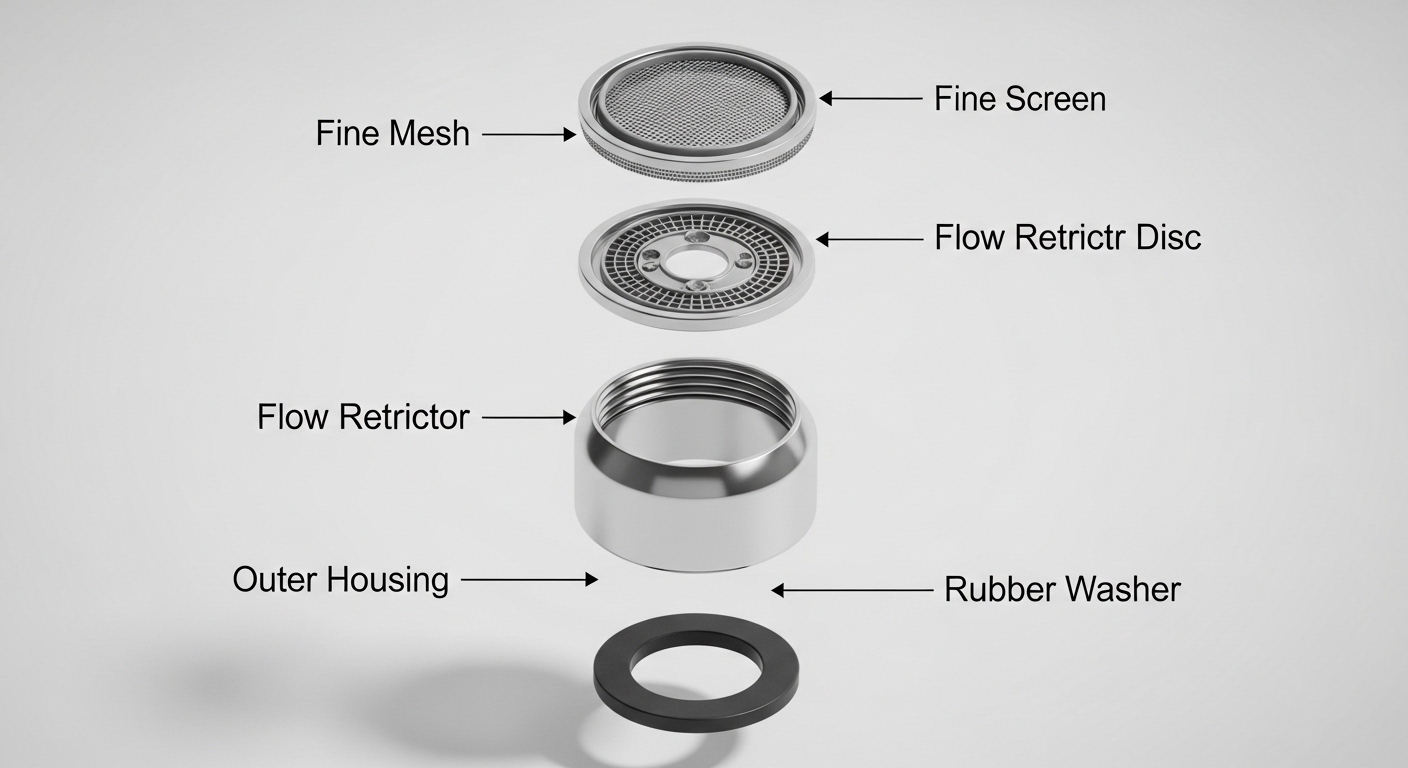
If you’ve got a faucet aerator leaking around the spout tip — either dripping from the threads, spraying sideways, or dribbling after you shut the handle off — the fix is usually 10 minutes and under $15. I’ve replaced and serviced hundreds of aerators across kitchen, bathroom, and bar faucets, and 9 out of 10 leaks come down to four predictable causes: a dried-out washer, limescale, a cross-threaded housing, or a cracked plastic insert. This guide walks you through how to diagnose which one you’re dealing with, the exact parts to buy, and when it’s smarter to just swap the whole aerator instead of fighting it.
This is a buyer’s guide as much as a repair guide. By the end you’ll know which aerator type fits your faucet (they’re not all interchangeable), which finishes and materials actually last, and what to look for if you want to upgrade to a quieter, water-saving model while you’re already under the spout.
What exactly is a faucet aerator, and why does it leak?
A faucet aerator is the small metal or plastic screen that screws onto the tip of your spout. It mixes air into the water stream, reduces splashing, filters out grit, and limits flow to somewhere between 0.5 and 2.2 GPM (gallons per minute). Inside that little housing there are typically four parts: an outer shell, a flow restrictor disc, a mesh screen, and a rubber washer or O-ring that seals it to the spout threads.
A faucet aerator leaking means one of those four parts has failed. The rubber washer hardens after 3–5 years and stops sealing. Calcium and magnesium deposits (“limescale”) clog the screen so water backs up and squeezes out the sides. The threads get cross-threaded if someone forced it on. Or the plastic insert cracks from over-tightening with pliers. None of these are serious problems — but ignoring them wastes 1–3 gallons per day and eventually corrodes the spout threads, which IS a serious problem.
Why is water dripping from the threads of my aerator instead of the spout?
If water is leaking from the seam where the aerator screws into the spout — not from the tip — the rubber washer inside the aerator has failed or the threads are no longer clean. This is the single most common faucet aerator leaking pattern, and it’s the easiest to fix.
Here’s what’s happening mechanically: water under pressure is taking the path of least resistance. When the washer is compressed and intact, that path is straight down through the screen. When the washer is dried out, cracked, or missing, water finds the spiral gap of the threads and dribbles sideways. You’ll usually see a slow drip on the underside of the spout or a wet ring on the sink deck.
To confirm the washer is the cause: unscrew the aerator by hand (counter-clockwise as you look up at it). Look at the rubber ring inside. If it’s flat instead of rounded, glossy-black instead of soft matte, or has a visible split, that’s your culprit. A replacement washer costs about $2 at any hardware store, but honestly — at that price point, replace the whole aerator. They come pre-assembled and the new one will outlast the old washer-only fix by years.
How do I remove a stuck faucet aerator without damaging the finish?
To remove a stuck aerator without scratching the finish, wrap the housing in a rubber band or a strip of duct tape (sticky side out), then grip it with pliers and turn counter-clockwise. If it still won’t budge, soak a rag in white vinegar, wrap it around the aerator for 30 minutes to dissolve the mineral lock, then try again.
Stuck aerators are usually the result of two things: galvanic corrosion between the brass spout and the aerator’s metal housing, or hardened limescale acting like glue. Here’s the order I work through, gentlest to most aggressive:
- Hand-twist first. Dry your hand thoroughly — wet hands slip. Many “stuck” aerators come off with a firm grip and a slow turn.
- Rubber band + pliers. Two thick rubber bands wrapped around the aerator give pliers something to grip without marring chrome, brushed nickel, or matte black finishes.
- Vinegar soak. Saturate a paper towel in white distilled vinegar, wrap it around the aerator, cover with a small sandwich bag, and rubber-band it in place. Leave for 30–60 minutes. This eats the mineral bond.
- Strap wrench. A $10 rubber strap wrench grips without scratching and gives you serious torque.
- Heat (last resort). A hair dryer on high for 60 seconds expands the brass and breaks the seize. Never use an open flame on a faucet.
If you have a hidden (recessed) aerator — common on Delta, Moen, and many modern designer faucets — you’ll need a special key, often included with the faucet or available as a $5 universal aerator key. Don’t try to grab a recessed aerator with pliers; you’ll wreck the spout opening. Once you’re down to bare threads, a similar approach applies to other common spout-end problems — there’s a parallel walkthrough in our guide on how to repair a loose faucet neck if you discover the looseness goes deeper than the aerator itself.
How do I clean a clogged aerator that’s making water spray sideways?
To clean a clogged aerator, unscrew it, disassemble the screen and washer, soak all metal and plastic parts in a 50/50 mix of white vinegar and warm water for 20–30 minutes, scrub the screen with an old toothbrush, rinse thoroughly, and reassemble. This fixes 80% of side-spraying or weak-stream aerators.
The reason sideways spray happens: limescale forms uneven crusts on the mesh, so some openings are blocked and others aren’t. Water hits the blockage, deflects, and shoots out at random angles. Same goes for the “splitting stream” where you suddenly have two streams instead of one — that’s a single piece of grit or scale wedged in the flow straightener.
Don’t use bleach or CLR on an aerator unless the package specifically says it’s safe for brass and rubber. CLR will degrade rubber washers within one or two soaks. Plain white vinegar is the right tool — it’s mild acetic acid, it dissolves calcium carbonate, and it won’t hurt the seals. For really stubborn mineral lockups, our deeper walkthrough on removing limescale and buildup from faucet bases covers the same chemistry applied to the bigger components.
What size and type of replacement aerator do I need?
Most U.S. residential faucets use one of three aerator thread sizes: 15/16″-27 (standard male, kitchen), 55/64″-27 (standard female, kitchen and bath), or 13/16″-24 (junior, bathroom). If you’re not sure which you have, take the old aerator to a hardware store — they have free gauges — or measure across the threads with a ruler. Anything between 15 and 17 mm is going to be one of those three.
Aerator type matters as much as thread size. Here’s how the common types compare for a typical kitchen or bathroom replacement.
| Aerator Type | Typical Flow | Best Use Case | Avg. Price | Pros | Cons |
|---|---|---|---|---|---|
| Standard Aerated | 1.5–2.2 GPM | Kitchen sinks, general bath use | $4–$10 | Quiet stream, mixes air, low splash | Slower fill rate for pots |
| Laminar Flow | 1.5–2.2 GPM | Hospitals, kitchens (clear stream look) | $8–$15 | No bacteria-harboring aeration, glass-like stream | More splash, costlier |
| Spray (Rose) Aerator | 1.0–1.5 GPM | Bathroom hand-washing | $5–$12 | Soft wide spray, water-saving | Not great for filling containers |
| Dual-Thread Swivel | 1.5–2.2 GPM | Garden hose adapters, utility sinks | $10–$18 | Fits both male and female threads, pivots | Bulky look, plastic internals |
| Low-Flow WaterSense | 0.5–1.0 GPM | Bathroom, eco-conscious homes | $6–$12 | EPA-certified, big water savings | Feels weak under low pressure |
One nuance most articles skip: if you have well water or hard municipal water (over 7 grains/gallon), avoid the cheap plastic flow restrictors in budget aerators. They clog within months. Spend the extra $5 for a brass-bodied aerator with a stainless mesh screen — you’ll get 3–5x the service life. If you’re dealing with broader water-quality symptoms beyond the aerator, our breakdown on why your faucet water is inconsistent walks through pressure, flow, and supply-side fixes.
When should I replace the whole faucet instead of just the aerator?
Replace the whole faucet (not just the aerator) when the spout threads are visibly corroded, the cartridge inside drips after the handle is off, the finish is flaking, or the faucet is more than 12–15 years old and you’re already three repairs in. Otherwise, an aerator swap is the smarter move 95% of the time.
Here’s the honest math. A solid replacement aerator is $5–$15. A mid-grade kitchen faucet is $150–$400. If your only complaint is the aerator dripping and the rest of the faucet works fine — handle turns smoothly, no base leaks, no cartridge drip — replacement is overkill. But if you’re seeing two or three of these warning signs at the same time, you’re throwing good money after bad:
- Green or white crusty corrosion on the spout threads (not just the aerator)
- Persistent dripping from the spout even after the aerator is replaced — that’s the cartridge, not the aerator
- Visible cracks, flaking, or peeling on the spout finish
- Wobbly base or loose connection at the deck (different problem — see our guide on repairing a loose bathroom faucet handle)
- Faucet is 12+ years old and the brand no longer makes replacement parts
- You’ve replaced the aerator twice in 18 months and it keeps failing — that means the spout threads are damaged
If you’re shopping for a full replacement, look for a faucet body made from lead-free solid brass (not zinc alloy), a ceramic disc cartridge rated to 500,000 cycles, and a PVD finish rather than electroplated. These three specs alone separate a faucet that lasts 15+ years from one that fails in 3. And while we’re talking finishes — a quick aside that gets asked a lot — chrome and brushed nickel are the easiest to source aerator replacements for, because they’re standard sizes. Matte black and champagne bronze finishes sometimes require finish-matched aerators that cost $20–$30 instead of $8.
How do I install a new aerator correctly so it doesn’t leak again?
To install a new aerator without leaks: align the threads carefully, hand-tighten clockwise only, then give it a quarter-turn with a rubber-banded pliers if needed. Never use Teflon tape on aerator threads — it actually causes leaks because aerator seals rely on the rubber washer, not thread tape.
The biggest installation mistake people make is over-tightening. Aerator threads are fine (27 threads per inch on most models), and they cross-thread or strip almost instantly if you crank them with a wrench. The seal isn’t created by metal-on-metal contact — it’s the compressed rubber washer doing 100% of the sealing work. Hand-tight plus a quarter turn is plenty.
- Run the faucet for 10 seconds with no aerator to flush any debris from the spout.
- Check the rubber washer is seated flat inside the new aerator — sometimes it ships crooked.
- Thread the aerator on by hand, slowly, feeling for the threads to catch. If it doesn’t spin freely, you’re cross-threading. Back off and restart.
- Once hand-tight, optionally use rubber-banded pliers for ¼ turn of additional snugness. Stop there.
- Turn on the faucet at full hot and cold. Look at the threads for any seepage. If you see water, the washer is misaligned — remove and reseat.
- Check again at 24 hours and 7 days. Rubber washers settle and may need a slight retightening.
If you’re doing this as part of a bigger install — say a brand-new faucet — the same principles about hand-tightening apply throughout. Our complete how to install a kitchen faucet guide covers the whole process from supply lines up.
What about hidden (recessed) aerators on modern designer faucets?
Hidden aerators sit flush inside the spout instead of screwing onto the outside, and they require a small plastic or metal “key” tool to remove. If yours is leaking, the fix is the same — clean or replace — but the access method is different. Don’t try to pry a recessed aerator out with a knife or screwdriver, or you’ll destroy the spout opening.
Each major brand uses a slightly different key shape. Moen’s M-PACT key, Delta’s “neoperl” key, and Kohler’s hex key are not interchangeable. Most new faucets ship with the key in the box — check the original packaging or owner’s manual envelope. If you’ve lost it, universal aerator key sets cost $5–$10 on Amazon and come with 6–8 common shapes.
The leak pattern on recessed aerators is usually different too: instead of dripping from threads, you’ll see water creeping around the outer edge of the spout opening or a sudden change in spray pattern. That’s because recessed aerators rely on a precision-fit O-ring, and when that O-ring fails, the water sneaks around the whole housing.
Materials and standards: what actually makes an aerator last?
The aerator industry has loose standards, which is why a $1 aerator from a discount bin behaves nothing like a $15 aerator from a reputable manufacturer. Look for these three certifications on the packaging or product page:
- NSF/ANSI 61 — certifies the materials are safe for drinking water contact (no lead leaching)
- EPA WaterSense — verifies flow rate claims and water-saving performance
- ASME A112.18.1 — the U.S. plumbing standard for faucet components, including aerators
Material matters too. Solid brass housings with stainless steel mesh screens last 10+ years. Plastic-bodied aerators with plastic flow restrictors typically fail in 1–3 years, especially with hard water. The rubber washer should be EPDM (ethylene propylene diene monomer) — it handles hot water and chlorinated municipal water without hardening. Cheaper “rubber” washers are often nitrile, which dries out in 18 months.
At WOWOW Faucet, every aerator we ship is brass-bodied, NSF/ANSI 61 certified, and backed by a limited lifetime warranty on the drip-free seal. We test every batch to 1.5x rated pressure (typically 90 PSI) before packaging. That’s the kind of spec you should be looking for from any aerator supplier, including ours — not just a low price tag.
FAQ
Why does my faucet aerator keep leaking right after I replace it?
Almost always one of three things: the threads on your spout are damaged (cross-threaded or corroded), you’re over-tightening and crushing the rubber washer, or you bought the wrong thread size. Inspect the spout threads under a flashlight. If they look chewed up, the spout itself needs replacement, not the aerator. If they look fine, hand-tighten only — no wrench — and the next replacement should hold.
Can I use plumber’s tape (Teflon) on aerator threads to stop a leak?
No. Plumber’s tape is designed for tapered pipe threads where the metal-on-metal seal does the work. Aerator threads are straight, and the seal comes entirely from the rubber washer. Adding Teflon tape actually prevents the washer from compressing evenly and often makes the leak worse. Skip it.
How often should I replace my faucet aerator even if it’s not leaking?
Every 2–3 years for hard-water households, every 4–5 years for soft-water households. Even without a visible leak, the rubber washer degrades, the screen builds up mineral deposits, and the flow restrictor slowly clogs. Proactive replacement at $8 every few years is cheap insurance against water damage and wasted water.
Will a low-flow aerator fix my high water bill?
Partially, yes. Swapping a 2.2 GPM aerator for a 1.0 GPM WaterSense model on a frequently-used kitchen faucet saves roughly 700 gallons per year for an average household. That’s about $5–$15 off your annual water bill, plus matching savings on water heating. Worth it, but it won’t single-handedly transform your bill — you’ll see bigger savings from fixing a running toilet or insulating your water heater.
My aerator looks fine but the water still sprays sideways. What gives?
Check the flow restrictor disc inside — it’s a small plastic or rubber piece with star-shaped openings. A single grain of grit lodged in it will cause sideways spray even when the screen looks clean. Disassemble fully, hold each piece up to light, and rinse with a strong stream. If the disc itself is cracked, replace the aerator. This is also a common symptom of why a new faucet still leaks right after installation.
Can a leaking aerator damage my sink or countertop?
Yes, over time. A slow drip from the aerator threads pools on the spout base, runs down the side, and can pit chrome finishes, stain stone countertops, and rot wood-trimmed sinks. It’s also a textbook cause of mineral rings around the faucet base. Catch and fix the leak within a week or two of noticing it, and you’ll avoid all of that.
Do all faucet brands use the same aerator size?
No. While 15/16″-27 (male) and 55/64″-27 (female) cover about 75% of U.S. residential faucets, premium and imported brands often use proprietary sizes — particularly recessed/hidden aerators. Before ordering online, unscrew yours and measure, or take it to a hardware store with a thread gauge.
Author note: This guide was written by the WOWOW Faucet technical content team in consultation with our in-house product engineers. WOWOW has been designing and manufacturing residential faucets and bathroom fixtures since 2003, with all aerator components tested to ASME A112.18.1 and NSF/ANSI 61 standards. Every WOWOW faucet ships with a limited lifetime warranty on the drip-free seal and finish.
\n
Related Guides
\n
- \n
- How to Fix A Leaky Faucet
- How Do I Fix a Leaky Faucet Cartridge Handle Myself in Under an Hour?
- How to Fix Fluctuating Water Pressure: A Complete Guide
\n
\n
\n
\n