 WOWOW Faucets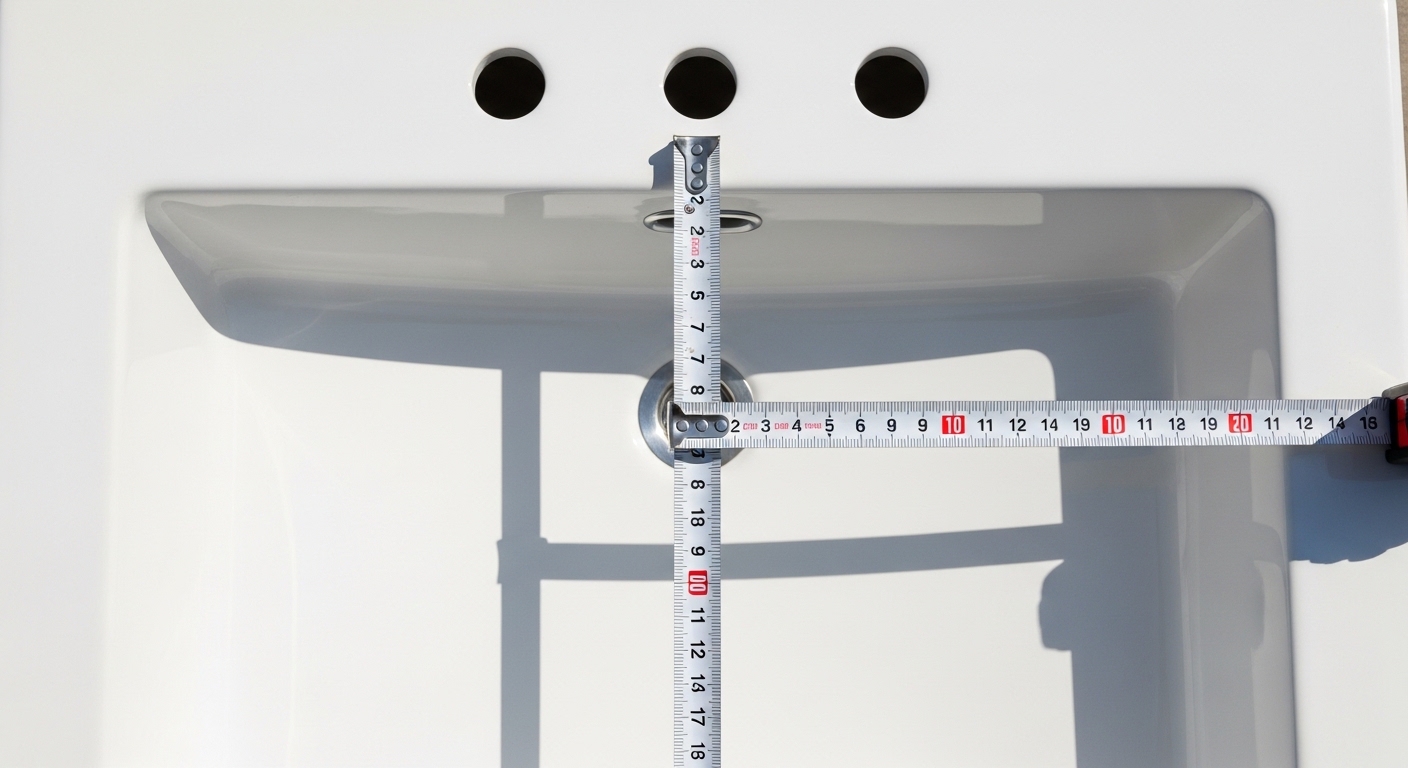
The vanity sink faucet hole size most homeowners are dealing with is a 1-3/8-inch (34.9 mm) round hole punched or drilled into the sink deck or countertop, with a common allowance up to 1-1/2 inches (38 mm). That single measurement — plus how many holes you have and how far apart they sit — decides which faucets will actually bolt on and which ones will leave you staring at an exposed, un-plumbable gap. Get it wrong and you’re either drilling porcelain, buying a deck plate to hide holes, or returning a faucet that physically can’t mount.
This guide walks you through exactly how to measure, what the standard numbers are, how to read hole spacing (which trips up more people than diameter), and what to do when your sink and faucet don’t match. It’s written for the person standing in the bathroom with a tape measure and a shopping cart open in another tab.
What is the standard vanity sink faucet hole size in inches and mm?
The standard vanity sink faucet hole is 1-3/8 inches (34.9 mm) in diameter. Nearly every mainstream bathroom faucet in North America is engineered to fit this, and most will also seat cleanly in a slightly larger 1-1/2-inch (38 mm) hole because the faucet’s base gasket and mounting washer cover the extra gap.
Here’s why the range exists. Sink and countertop manufacturers drill to 1-3/8 inches as the target, but tolerances, material (porcelain vs. granite vs. stainless), and the drill bit used mean real-world holes land anywhere from 1-1/4 inch to 1-1/2 inch. Faucet makers know this, so they publish a “fits holes up to X” spec rather than a single exact number. As long as your hole is at least as wide as the faucet’s threaded shank and no wider than the base of the faucet body or its included escutcheon, you’re fine.
- 1-3/8 in (34.9 mm) — the true standard; assume this unless you measure otherwise.
- Up to 1-1/2 in (38 mm) — the common maximum most faucets accommodate.
- 1-1/4 in (32 mm) — occasionally seen on older or imported vanities; some slim single-hole faucets need this or won’t drop through.
One thing that surprises people: the hole diameter is the same whether you have one hole or three. What changes between faucet styles is not the size of each hole but how many there are and how far apart they sit. That spacing is the number that actually determines faucet compatibility, so let’s tackle it next.
How do I know if I have a single-hole, centerset, or widespread setup?
Count your holes, then measure the distance between the centers of the two outermost holes. One hole means single-hole; three holes 4 inches apart center-to-center means centerset; three holes 8-16 inches apart means widespread. That measurement — not the individual hole diameter — is what you match to a faucet’s “spread” spec.
Measure from the center of the left hole to the center of the right hole, not edge to edge. This is the single most common measuring mistake, and it throws you off by roughly the hole diameter (about 1-3/8 inch), which is enough to buy the wrong faucet.
| Configuration | Number of holes | Center-to-center spread | Best for |
|---|---|---|---|
| Single-hole | 1 | N/A (one 1-3/8″ hole) | Small vanities, modern/minimalist looks, powder rooms |
| Centerset | 3 (or 1 with a base plate) | 4 inches | Standard bathroom sinks, budget-friendly, easy swaps |
| Widespread | 3 separate pieces | 8 inches (adjustable 6-16″) | Larger vanities, upscale/custom look, flexible spacing |
| Mini-widespread | 3 | 4 inches | Widespread style on a standard 4″ hole layout |
A few practical notes on reading your own sink:
- Centerset faucets combine the spout and both handles on a single base (an escutcheon plate) that spans the 4-inch spread. They cover three holes but function as one unit.
- Widespread faucets are three physically separate pieces — spout in the middle, two independent handles — connected underneath by flexible tubing. The 8-inch spread is standard, but true widespreads adjust, so the same faucet fits a range of 6 to 16 inches.
- Single-hole faucets put spout and handle (or handles) on one post through one hole. Many single-hole faucets ship with an optional deck plate so they can also cover a 4-inch 3-hole sink if you decide to switch later.
If you’re setting up a one-hole countertop specifically and want the fuller rundown on that style, our guide to the best single hole sink faucet setup for a one-hole countertop walks through spout height, reach, and deck-plate options that apply just as much to a bathroom vanity.
How do I measure my vanity faucet holes correctly?
Clear the sink deck, then measure three things: the diameter of one hole, the number of holes, and the center-to-center distance between the outer holes. A rigid tape measure or steel ruler is enough; you don’t need calipers for a job with this much built-in tolerance.
Do it in this order:
- Remove the old faucet (or at least look underneath) so you can see the raw holes clearly. On many drop-in sinks the holes are hidden by the faucet base.
- Measure one hole’s diameter across the widest point of the opening. Expect 1-3/8 inch. If it reads noticeably smaller (1-1/4″) or larger (1-1/2″), note it — that affects which faucets drop through.
- Count the holes. One, three, or occasionally four (the extra is for a side sprayer or soap dispenser).
- Measure center-to-center on the two outermost holes. Put the tape on the middle of the left hole and read the middle of the right hole. 4 inches = centerset; 8 inches = widespread.
- Check deck thickness — the distance from the top surface to the underside. Thick stone or double-layer decks (over about 1-1/4 inch) can be too deep for a short faucet shank, so confirm the faucet’s mounting range covers your deck.
Measuring is the same discipline you’d use for any fixture where a fraction of an inch decides fit — the same care that matters when you’re figuring out what outdoor faucet size you actually need. Measure twice, buy once. A phone photo of the deck with a tape measure laid across it is also worth taking, so you can reference it while shopping.
What if my faucet has fewer holes than my sink — or more?
If your faucet needs fewer holes than your sink has, use a deck plate (escutcheon) to cover the extras — no drilling required. If your faucet needs more holes than your sink has, you’ll either drill new holes or choose a different faucet style. Deck plates solve the far more common problem cheaply.
Real scenarios:
- Three-hole sink, want a single-hole faucet: Buy a single-hole faucet that includes (or offers) a deck plate. The plate sits over all three holes; the faucet mounts through the center. This is the easiest, most reversible upgrade and the most popular modernizing move.
- One-hole sink, want a widespread faucet: This is the hard direction. A true widespread needs three separate holes 8 inches apart. Drilling porcelain or stone is risky (cracking, chipping) and often not worth it — choose a single-hole faucet instead, or a mini-widespread if you can drill.
- Three-hole 4″ sink, want a widespread look: Get a mini-widespread, which delivers the separated three-piece appearance on standard 4-inch hole spacing.
- Extra fourth hole from an old sprayer: Cover it with a matching hole cover or use it for a soap dispenser.
Deck plates typically range from about 4 to 10 inches long and come in finishes to match the faucet, so plan to buy the plate in the same finish and brand family for a seamless look. If you’re weighing traditional styling, the Victorian centerset faucet is a good example of a 4-inch three-hole design that mounts on the most common vanity layout without any drilling.
Does countertop material change the hole size or how I drill?
The target hole size stays 1-3/8 inch regardless of material, but how you create or enlarge a hole changes completely between porcelain, stone, and stainless. Porcelain and stone crack under the wrong bit or too much pressure; stainless and composite are more forgiving.
Material-by-material reality:
- Vitreous china / porcelain sinks: Holes are molded in at the factory. Drilling new ones aftermarket is high-risk — porcelain chips and cracks easily. Work with the holes you have.
- Granite, quartz, marble countertops: Drillable with a diamond hole saw, water cooling, and patience, but it’s a job many people leave to a fabricator. A cracked stone top is an expensive mistake.
- Stainless steel / composite: Can be drilled or enlarged with a step bit or hole saw more safely, though it’s still precise work.
Because drilling risk is real, the smart sequence is: confirm your existing hole layout first, then shop for a faucet that matches it — not the other way around. When your holes and faucet already agree, installation is a plumb-and-tighten job, not a fabrication project.
What size supply lines and mounting hardware come with the hole size?
Faucet supply connections are a separate spec from the deck hole, but they matter for a complete install. Most bathroom faucets use 3/8-inch compression supply line connections at the shutoff valves, and the faucet’s own inlet tubing is usually 3/8-inch or 1/2-inch, so you’ll match your supply lines to that — not to the 1-3/8-inch deck hole.
Don’t confuse the two measurements:
| Measurement | Typical size | What it’s for |
|---|---|---|
| Deck / mounting hole | 1-3/8 in (up to 1-1/2 in) | The hole the faucet body drops through |
| Hole spread (center-to-center) | 4 in or 8 in | Determines centerset vs. widespread |
| Supply line connection | 3/8 in compression (valve side) | Connecting faucet to shutoff valves |
| Faucet inlet / shank | 3/8 in or 1/2 in | The faucet’s own water inlet fitting |
When you buy a faucet, the mounting hardware — gasket, base plate, mounting nut, and often flexible braided supply hoses — comes in the box and is sized to that faucet’s shank. You typically only buy separately the two supply lines that run from the wall shutoffs to the faucet inlets, and those are usually 3/8-inch compression on the valve end. If you’re getting weak flow after an install, that’s usually a supply or aerator issue rather than a hole-size issue; our guide on low water pressure from a sink faucet covers the usual suspects.
Quick decision guide: which faucet fits my vanity?
Match your measured holes to the faucet type below, and you’ll almost never return a faucet:
- 1 hole: Single-hole faucet. (Add a deck plate later if you ever move to a 3-hole sink.)
- 3 holes, 4 inches apart: Centerset or mini-widespread faucet.
- 3 holes, 8 inches apart: Widespread faucet.
- 3 holes but you want a clean single-post look: Single-hole faucet + matching deck plate.
- Deck thicker than ~1-1/4 inch: Confirm the faucet’s mounting range covers thick decks before buying.
Every WOWOW bathroom faucet lists its required hole count and spread on the product page, and single-hole models note whether a deck plate is included, so you can match your measurements before you check out.
FAQ
Is the standard vanity faucet hole size the same as a kitchen faucet hole?
Yes — both bathroom and kitchen faucets use the same standard 1-3/8-inch (34.9 mm) mounting hole, with most fitting up to 1-1/2 inches. The difference between kitchen and bath faucets is spout size, reach, and hole spread, not the diameter of each individual hole.
Can I put a single-hole faucet on a 3-hole vanity sink?
Yes. Use a single-hole faucet that includes a deck plate (escutcheon). The plate covers the two outer holes while the faucet mounts through the center hole. Many single-hole faucets ship with the plate specifically so they fit both one-hole and standard 4-inch three-hole sinks. No drilling needed.
What happens if my hole is slightly bigger than 1-3/8 inch?
Up to about 1-1/2 inches, you’re fine — the faucet’s base gasket and mounting washer cover the extra gap. If the hole is significantly larger than 1-1/2 inches, use a wider-based faucet or a deck plate to hide the opening. The faucet’s mounting nut still tightens underneath regardless.
How far apart are widespread faucet holes exactly?
Widespread faucet holes are standardly 8 inches center-to-center, but because a true widespread connects underneath with flexible tubing, the same faucet adjusts to fit anywhere from about 6 to 16 inches apart. Always measure center-to-center on your two outer holes, not edge to edge.
Do I need to drill new holes to change my faucet?
Usually not. If you match a new faucet to your existing hole count and spread, it bolts right on. You only need to drill if you’re going from fewer holes to a style that requires more — like a one-hole sink to a true widespread. Because porcelain and stone crack easily, most people choose a faucet that fits their current holes instead of drilling.
What size are the water supply lines for a vanity faucet?
Bathroom faucet supply lines are typically 3/8-inch compression on the shutoff-valve end, connecting to the faucet’s 3/8-inch or 1/2-inch inlets. This is separate from the 1-3/8-inch deck hole — the hole size is about mounting the faucet body, while the supply size is about connecting water. Faucets usually include the flexible inlet hoses in the box.
A note on expertise, testing, and warranty
About the author: This guide was written by the WOWOW product content team, drawing on hands-on installation of centerset, widespread, and single-hole bathroom faucets across vitreous china, quartz, and stainless vanities. We’ve measured, mounted, and occasionally re-measured enough sinks to know that spread — not diameter — is where most people go wrong.
About WOWOW: WOWOW designs and sells kitchen and bathroom faucets, shower systems, and fixtures direct to homeowners. Our faucets are built to standard North American hole dimensions (1-3/8-inch mounting holes, 4-inch centerset and 8-inch widespread spreads) so they drop into the vast majority of existing vanities without modification. Products are tested to meet ANSI/NSF and cUPC standards for safe drinking-water contact and flow, and our bathroom faucets are backed by a limited lifetime warranty against leaks and finish defects. Always follow the installation sheet included with your specific model, and confirm your measurements against the product page before purchasing.