 WOWOW Faucets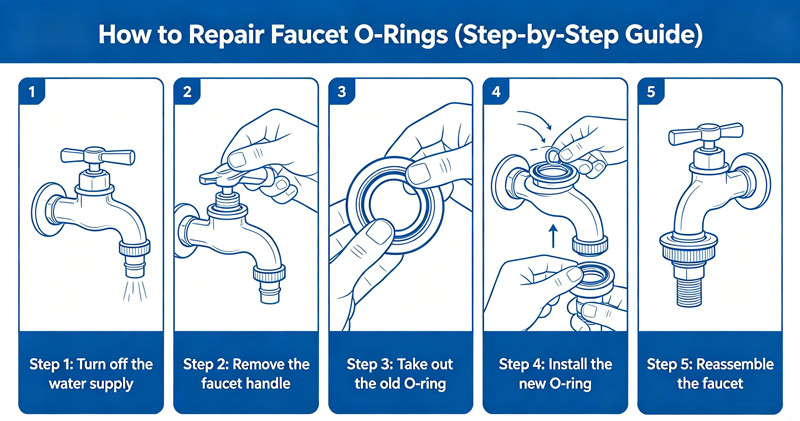
If your faucet is leaking around the base of the spout or dripping even when turned off, worn or damaged O-rings are often the culprit. These small rubber seals play a big role in keeping your faucet watertight. The good news? Replacing or repairing O-rings is one of the easiest and most affordable plumbing fixes you can do yourself.
This guide walks you through what O-rings do, how to identify problems, and how to repair or replace them step by step.
What Are Faucet O-Rings?
O-rings are small, circular rubber seals located inside your faucet. They sit around moving parts—especially the spout—and create a tight seal to prevent water from escaping.
Common locations:
- Around the base of the spout
- Inside the faucet body
- Around cartridges or valve stems
Over time, O-rings can wear out due to friction, mineral buildup, and constant exposure to water.
Signs Your O-Rings Need Repair
Before starting, confirm that O-rings are the issue.
Common symptoms:
- Water leaking from the base of the spout
- Drips when the faucet is turned on
- Loose or wobbly spout
- Reduced water efficiency
If the leak is coming from under the sink, the issue may be elsewhere. But if it’s around the spout or handle, O-rings are a likely cause.
Tools and Materials You’ll Need
You don’t need much to fix O-rings:
- Adjustable wrench
- Allen wrench (hex key)
- Flathead screwdriver
- Replacement O-rings (correct size)
- Silicone plumber’s grease
- Clean cloth or rag
Tip: Take the old O-ring to a hardware store to match the exact size.
Step-by-Step: How to Repair Faucet O-Rings
Step 1: Turn Off the Water Supply
Locate the shut-off valves under the sink and turn them off. Then turn on the faucet to release any remaining pressure.
Step 2: Remove the Faucet Handle (If Needed)
Depending on your faucet design, you may need to remove the handle to access internal parts.
- Look for a small set screw (often hidden)
- Use an Allen wrench to loosen it
- Lift off the handle carefully
Step 3: Remove the Spout
For most faucets, the spout can be removed to access the O-rings.
- Gently twist and pull the spout upward
- If stuck, wiggle it slightly—don’t force it
- Some models may require loosening a retaining nut first
Once removed, you’ll see one or more O-rings around the base.
Step 4: Inspect the O-Rings
Carefully examine the O-rings for damage.
Look for:
- Cracks or splits
- Flattened or worn shape
- Hard or brittle texture
Even if damage isn’t obvious, old O-rings should be replaced if they’ve been in use for years.
Step 5: Remove the Old O-Rings
Use a flathead screwdriver or your fingers to gently remove the O-rings.
⚠️ Be careful not to scratch the metal surface underneath, as this can cause future leaks.
Step 6: Clean the Area
Before installing new O-rings, clean the surface thoroughly.
- Wipe away mineral deposits and debris
- Use vinegar if needed to remove buildup
- Dry the area completely
A clean surface ensures a proper seal.
Step 7: Apply Plumber’s Grease
Apply a thin layer of silicone plumber’s grease to the new O-rings.
Why this matters:
- Helps create a better seal
- Reduces friction during movement
- Extends the lifespan of the O-rings
Avoid petroleum-based products—they can damage rubber.
Step 8: Install New O-Rings
Slide the new O-rings into place.
- Make sure they sit evenly in their grooves
- Avoid twisting or stretching them
- Ensure proper fit—too loose or too tight can cause leaks
Step 9: Reassemble the Faucet
- Reinstall the spout carefully
- Reattach the handle if removed
- Tighten screws and fittings securely (but not too tight)
Everything should feel smooth and aligned.
Step 10: Turn Water Back On and Test
Turn the water supply back on and test your faucet.
Check for:
- Leaks around the base
- Smooth spout movement
- Proper water flow
If there’s no dripping, your repair was successful.
Common Mistakes to Avoid
Even a simple repair can go wrong if you’re not careful.
Avoid these mistakes:
- Using the wrong O-ring size
- Skipping lubrication
- Over-tightening parts
- Damaging surfaces during removal
- Reusing old or worn O-rings
Attention to detail makes all the difference.
When to Replace Instead of Repair

Sometimes replacing O-rings isn’t enough.
Consider replacing the faucet if:
- The metal surface is corroded or scratched
- The faucet is very old or low quality
- Leaks persist after multiple repairs
In these cases, a new faucet may be more cost-effective long term.
Tips to Extend O-Ring Lifespan
Prevent future issues with a few simple habits:
- Clean your faucet regularly
- Avoid harsh chemicals
- Use gentle movement when rotating the spout
- Apply plumber’s grease during maintenance
- Address leaks early
These steps can significantly extend the life of your faucet components.
Final Thoughts
Repairing faucet O-rings is a quick, inexpensive fix that can solve many common leaks. With just a few tools and a bit of patience, you can restore your faucet to like-new condition in under an hour.
The key steps are simple: identify the problem, replace worn O-rings, lubricate properly, and reassemble carefully. Once done, your faucet should operate smoothly and leak-free.
Learning how to handle small repairs like this not only saves money but also gives you more confidence in maintaining your home. And when it comes to plumbing, a little knowledge goes a long way.\n
Related Guides
\n
- \n
- How to Fix A Leaky Faucet
- How Do I Fix a Leaky Faucet Cartridge Handle Myself in Under an Hour?
- How to Fix Fluctuating Water Pressure: A Complete Guide
\n
\n
\n
\n