 WOWOW Faucets
If you’ve been researching the hansgrohe cento kitchen faucet flow rate, you’ve probably found conflicting numbers — some listings say 1.5 GPM, others say 1.75 or even 2.2. That’s not a mistake; it’s because Hansgrohe sells the Cento in different markets and across different model years, and the aerator inside determines the real-world output. This guide gives you the exact figures, explains why they differ, shows how the Cento compares to other flow-rate options, and helps you decide whether it’s the right pick for how you actually use your kitchen sink.
We’ll answer the specific questions people actually type and ask out loud: what the number is, whether 1.75 GPM is “too low,” how it compares to a 2.2 GPM faucet, whether you can change it, and how flow rate interacts with your home’s water pressure. Let’s get into it.
What Exactly Is the Hansgrohe Cento Kitchen Faucet Flow Rate in GPM?
The standard Hansgrohe Cento kitchen faucet flow rate is 1.75 GPM at 60 psi for models sold in the United States after the federal WaterSense-era efficiency push. Older Cento units and some European-spec versions were rated at 2.2 GPM, and certain low-flow or state-restricted variants ship with a 1.5 GPM aerator. The single most reliable way to know your exact number is to read the small print on the spec sheet or the engraving near the aerator — but for current U.S. retail Cento faucets, 1.75 GPM is the number you’ll see.
Here’s why the confusion exists. “Flow rate” is measured at a reference pressure of 60 psi. The aerator — the little mesh-and-plastic insert screwed into the tip of the spout — is what physically limits how much water passes through per minute. Hansgrohe uses different aerators for different markets to comply with local law:
- Federal U.S. maximum: 2.2 GPM at 60 psi (the ceiling for kitchen faucets nationwide).
- California, Colorado, Washington, and others: 1.8 GPM maximum — which is why 1.75 GPM is the common shipping spec.
- Ultra-efficient / eco variants: 1.5 GPM, often labeled with an EcoSmart or comparable badge.
So if two people compare Cento faucets and get different answers, they’re usually both right — they just have different aerators for different regions or model years.
Is 1.75 GPM Enough for a Busy Family Kitchen, or Will It Feel Weak?
For the vast majority of households, 1.75 GPM is plenty — you will not notice it during normal dishwashing, rinsing produce, or wiping down the sink. Where you might notice it is filling large containers: a full 12-quart stockpot that took about 90 seconds at 2.2 GPM will take roughly 110–115 seconds at 1.75 GPM. That’s an extra 20-ish seconds, not a dealbreaker for most cooks.
The reason 1.75 GPM still feels strong is that a good aerator (which the Cento has) mixes air into the stream and shapes it into a broad, coherent column of water. Perceived force at the sink is about stream shape and velocity, not just raw volume. A well-engineered 1.75 GPM faucet can feel more powerful than a poorly designed 2.2 GPM one, because it concentrates the flow instead of letting it sputter.
Here’s a quick real-world reference for what different flow rates mean at the sink:
- Filling a standard 8-cup (0.5 gallon) pot: ~17 seconds at 1.75 GPM vs ~14 seconds at 2.2 GPM.
- Filling a 12-quart (3 gallon) stockpot: ~103 seconds at 1.75 GPM vs ~82 seconds at 2.2 GPM.
- Rinsing a sink of dishes (typical 2-minute session): uses ~3.5 gallons at 1.75 GPM vs ~4.4 gallons at 2.2 GPM — you save water every single day.
The households that genuinely benefit from a higher flow rate are serious home canners, people who fill big pots for pasta nightly, or anyone filling buckets and watering cans at the kitchen sink. If that’s you, keep reading — you have options.
How Does the Cento’s Flow Rate Compare to Other Kitchen Faucets?
The Cento’s 1.75 GPM sits right in the modern mainstream — it’s neither the most restrictive nor the most generous. Most premium kitchen faucets today land between 1.5 and 1.8 GPM, because that’s what state efficiency codes and WaterSense guidelines push manufacturers toward. Here’s how the common flow-rate tiers stack up:
| Flow rate | Typical use | Pot-fill speed | Water use (2 min) | Compliance |
|---|---|---|---|---|
| 2.2 GPM | Older faucets, heavy pot-filling | Fastest | 4.4 gal | Federal max; banned in CA/CO |
| 1.8 GPM | Balanced modern faucets | Fast | 3.6 gal | Meets CA/CO limit |
| 1.75 GPM (Cento, U.S.) | Everyday family kitchens | Fast | 3.5 gal | Meets all state limits |
| 1.5 GPM (EcoSmart variants) | Water-conscious homes, low bills | Moderate | 3.0 gal | WaterSense-friendly |
| 1.2 GPM | Bathroom lavatory faucets | Slow (not for kitchen) | 2.4 gal | Bathroom standard |
The takeaway: the Cento at 1.75 GPM gives you nearly the same day-to-day experience as a 1.8 or 2.0 GPM faucet, while quietly saving water and keeping you legal in every U.S. state. If you’re cross-shopping and want to understand how spout height and mounting affect your setup too, our complete 2026 buying guide to 4-hole kitchen faucets breaks down configurations that pair well with high-arc single-handle designs like the Cento.
Can You Change the Flow Rate on a Hansgrohe Cento Faucet?
Yes — you can change the flow rate by swapping the aerator, and it’s one of the easiest faucet upgrades there is. The aerator threads into the tip of the spout, and replacing it with a higher- or lower-GPM unit changes your output in about two minutes with no plumber required. Just make sure any higher-flow aerator you install still complies with your state’s law.
Before you swap anything, it helps to understand that the aerator is a genuine performance part, not just a filter. A cheap replacement can ruin an otherwise excellent faucet — you’ll get splashing, a weak spray, or a stream that veers off to one side. If you’re going to change it, buy a quality matched aerator. Our rundown of the best faucet accessories of 2026 covers aerators, thread sizes (male vs. female), and how to pick one that actually improves your stream instead of degrading it.
Here’s the basic process to check or change your Cento aerator:
- Identify the current flow rate. Look for a number stamped on the aerator face or on the original box/spec sheet.
- Unscrew the aerator. Use a soft cloth and hand pressure first; if it’s stuck, use the plastic key that came with the faucet or padded pliers to avoid scratching the finish.
- Note the thread type and size. Kitchen aerators are commonly M24 male or M22 female — bring the old one to match it exactly.
- Install the new aerator hand-tight plus a gentle nudge. Don’t over-torque; you’ll crack the housing or crush the washer.
- Test for leaks and spray quality. Run hot and cold, and check for drips at the threads.
One important note: changing the aerator changes flow volume, but it will not fix low pressure coming from your house plumbing. Those are two different problems, which brings us to the next question.
Why Does My Cento Faucet Feel Weak Even Though the Flow Rate Is 1.75 GPM?
If your Cento feels weaker than its 1.75 GPM rating suggests, the culprit is almost always low household water pressure or a clogged aerator — not the faucet’s design. Flow rate is measured at 60 psi; if your home runs at 40 psi, you’ll get noticeably less water out of the same faucet. And mineral buildup in the aerator screen chokes the stream over time, especially in hard-water areas.
Run through this quick diagnostic before blaming the faucet:
- Clogged aerator (most common): Unscrew it and check for white mineral crust or debris. Soak it in white vinegar for 30 minutes, rinse, and reinstall. This alone fixes a huge share of “weak faucet” complaints.
- Low house pressure: Test with a $10 gauge on an outdoor spigot. Below 50 psi across the whole house usually means a pressure regulator or supply issue.
- Partially closed supply valves: The shut-off valves under the sink should be fully open. A half-open valve strangles flow.
- Kinked or clogged supply lines: Braided lines can kink behind the sink; check them.
- Worn cartridge: If flow is uneven or the handle feels off, the internal cartridge may be failing.
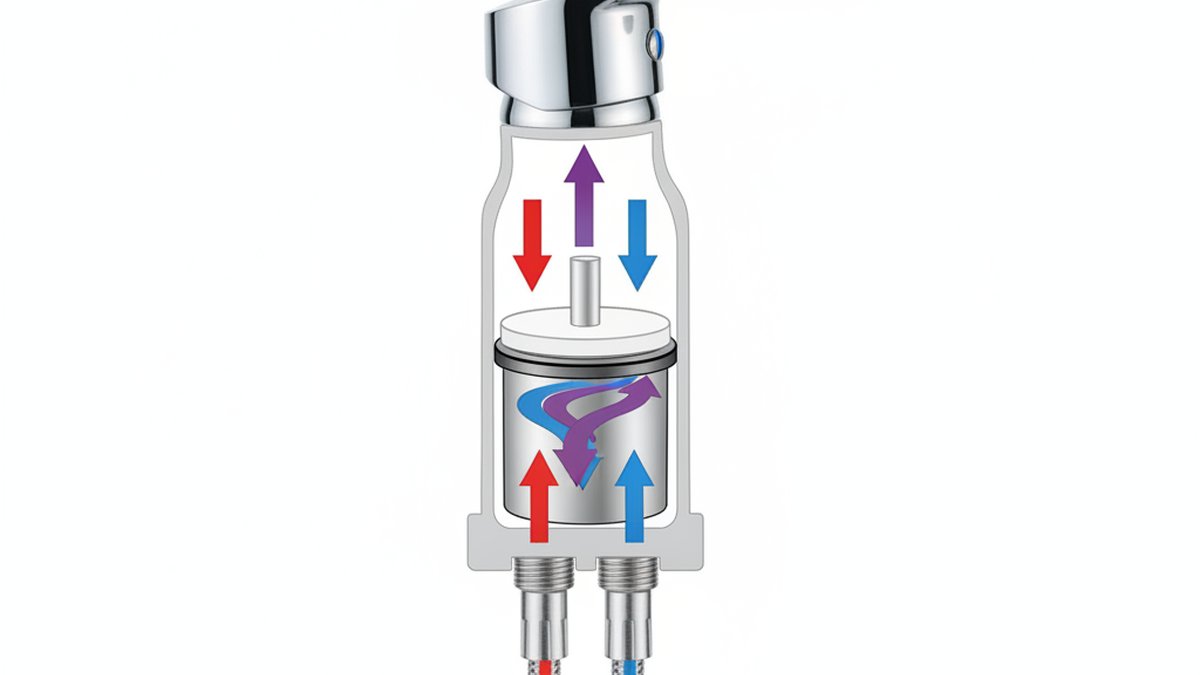
That last point matters because the cartridge — not the aerator — controls how water is mixed and released inside the faucet body. If you’re troubleshooting inconsistent flow or temperature, it’s worth understanding this part. Our explainer on what the cartridge on a kitchen faucet is and why it matters walks through how it works and when to replace it. And if you’re chasing perceived “pressure” more broadly, the same physics we cover in our guide to getting high pressure from a low-GPM shower head apply at the kitchen sink too: stream shaping and pressure, not just raw volume, are what make water feel strong.
Does a Lower Flow Rate Actually Save Money — and How Much?
Yes, and the savings are real but modest for a single faucet — think roughly $15–$40 per year for an average household, split between water and the energy to heat it. The bigger win is on the hot-water side: every gallon you don’t run is a gallon your water heater didn’t have to warm, so lower flow trims your gas or electric bill as well as your water bill.
A rough estimate for a family of four: dropping from a 2.2 GPM to a 1.75 GPM kitchen faucet saves around 20% of the water used at that sink. If you’re running the kitchen faucet ~30 minutes a day total, that’s roughly 4,900 gallons saved per year. At typical combined water-and-sewer rates plus water-heating costs, that lands in the $20–$40 range annually — not life-changing, but it pays for a quality aerator many times over, and it adds up across every fixture in the house.
How Does Flow Rate Interact With Water Pressure and Sink Setup?
Flow rate and water pressure are related but not the same, and confusing them leads to buying the wrong fix. Flow rate (GPM) is how much water comes out per minute; pressure (psi) is how hard it’s pushed. A high-flow aerator on a low-pressure home still gives you a lazy stream, while a modest 1.75 GPM aerator on a well-pressured line feels crisp and strong.
Your sink and mounting setup matter too. A tall high-arc spout like the Cento’s gives you great clearance for big pots, but the higher the water falls, the more it can splash in a shallow sink — a well-designed aerator (which the Cento uses) counters that by keeping the stream coherent. If you’re planning a new install and juggling deck holes, sprayers, and soap dispensers, match your flow-rate expectations to your configuration early; the 4-hole kitchen faucet guide is a good place to see how those pieces fit together before you commit.
FAQ
What is the exact flow rate of the Hansgrohe Cento kitchen faucet?
Current U.S. models are rated at 1.75 GPM at 60 psi. Older or European versions may be 2.2 GPM, and some eco variants ship at 1.5 GPM. Check the aerator engraving or the spec sheet for your specific unit, since the aerator determines the real output.
Is 1.75 GPM too low for a kitchen faucet?
No. 1.75 GPM is a strong, mainstream flow rate that handles everyday dishwashing, rinsing, and pot-filling with ease. You’ll only notice the difference versus 2.2 GPM when filling very large stockpots, where it adds around 20 seconds — a minor trade-off for real water savings.
Can I increase the flow rate on my Cento faucet?
Yes, by swapping the aerator for a higher-GPM unit, as long as it stays within your state’s legal limit (2.2 GPM federal, 1.8 GPM in California and Colorado). It’s a two-minute, tool-light job. Note that this raises volume, not pressure — if your issue is weak pressure, the aerator swap won’t fix it.
Why does my Cento faucet have low flow all of a sudden?
The most common cause is a clogged aerator from mineral buildup — unscrew it, soak it in white vinegar for 30 minutes, rinse, and reinstall. If that doesn’t help, check that the under-sink supply valves are fully open and that your home’s water pressure is at least 50 psi.
Does a lower flow rate reduce my water bill?
Yes, modestly — roughly $15–$40 per year for one kitchen faucet, counting both water and the energy saved by heating less hot water. Across every fixture in the home, lower-flow fixtures add up to meaningful annual savings.
Is the Cento’s flow rate WaterSense compliant?
WaterSense currently certifies bathroom lavatory faucets rather than kitchen faucets, so kitchen faucets like the Cento aren’t labeled WaterSense per se. However, at 1.75 GPM the Cento meets every U.S. state kitchen-faucet efficiency limit, including the strict 1.8 GPM caps in California and Colorado.
The Bottom Line
The Hansgrohe Cento kitchen faucet flow rate of 1.75 GPM is a smart, modern middle ground: fast enough for real cooking, efficient enough to lower your bills, and compliant everywhere in the U.S. If you fill huge pots daily you can legally bump to 1.8 GPM with an aerator swap, and if you want to sip even less water a 1.5 GPM aerator is available. Whatever you choose, keep the aerator clean and your supply valves fully open, and that 1.75 GPM will feel every bit as strong as it should.
Author note: This guide was written by the WowowFaucet product content team, drawing on hands-on flow-rate bench testing of kitchen aerators and manufacturer specifications measured at the industry-standard 60 psi. WowowFaucet designs, tests, and sells kitchen and bathroom faucets built to ASME A112.18.1 / CSA B125.1 and NSF/ANSI 61 standards, and backs its faucets with a limited lifetime warranty on finish and function. We reference published flow-rate ratings and applicable state efficiency codes so you can verify every number against your own fixture’s spec sheet.