 WOWOW Faucets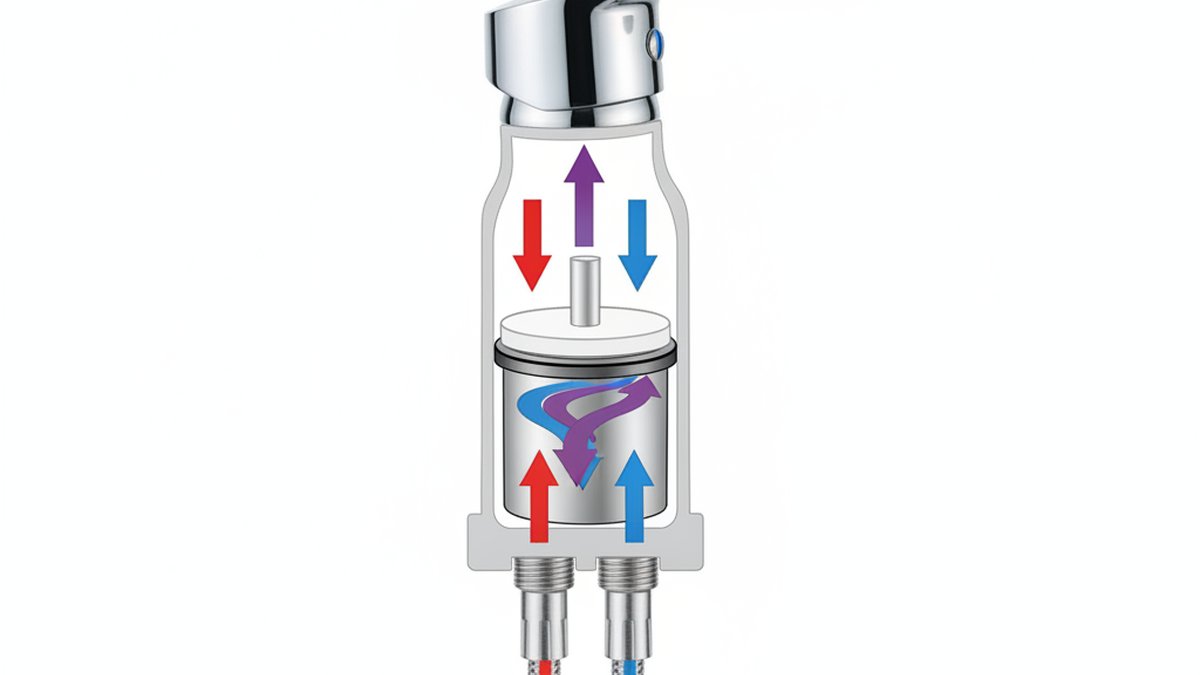
If you’ve ever wondered what is the cartridge on a kitchen faucet, here’s the simplest way to picture it: it’s the “brain” of the faucet. Everything you do with the handle — turning water on, adjusting temperature, shutting it off — happens because a cartridge inside is opening, closing, and blending the hot and cold supply lines. It’s a cylinder (usually plastic, brass, or ceramic) that sits under the handle, and it does the actual work while the shiny spout and lever just get the credit.
Most people never think about this part until something goes wrong. Then, suddenly, it’s the single most important component in your kitchen. The good news: once you understand what the cartridge does and how to spot a failing one, you can diagnose the vast majority of faucet problems yourself and skip the plumber’s service call.
What does a faucet cartridge actually do?
A faucet cartridge controls the flow rate and the mix of hot and cold water. When you lift or turn the handle, you’re moving the cartridge’s internal discs or seals so that openings line up and let water through — more openings for higher flow, and different alignments for hotter or colder water.
Inside a modern cartridge you’ll typically find two polished ceramic discs stacked together. One disc stays fixed; the other rotates or slides as you move the handle. When the holes in the two discs overlap, water flows. When you push the handle down, the holes shift out of alignment and the water stops. Because ceramic is extremely hard and smooth, these discs can seal against each other tens of thousands of times without leaking — which is exactly why ceramic-disc cartridges have become the standard on quality faucets.
The cartridge is also what protects you from scalding surprises. It’s the part that “remembers” your temperature setting and holds it steady, so the water doesn’t lurch from warm to boiling when someone flushes a toilet elsewhere in the house.
What are the different types of kitchen faucet cartridges?
There are four common valve types, and the cartridge you need depends on which your faucet uses. Ceramic disc is the most durable and the most common on faucets made in the last decade, while compression and ball valves are older designs you’ll mostly find on aging fixtures.
| Cartridge / Valve Type | How It Works | Typical Lifespan | Best For |
|---|---|---|---|
| Ceramic disc | Two polished ceramic discs slide to open/close and mix water | 15–20+ years | Modern single- and two-handle faucets; hard-water areas |
| Cartridge (brass/plastic) | A stem-style insert with rubber O-rings that raises/rotates | 10–15 years | Single-handle faucets; easy DIY replacement |
| Ball valve | A slotted metal ball rotates over rubber seats and springs | 8–12 years | Older single-handle kitchen faucets |
| Compression | A rubber washer presses against a seat to stop flow | 5–10 years | Older two-handle faucets; cheapest to repair |
For a kitchen faucet specifically, you’re most likely dealing with either a ceramic-disc cartridge or a standard stem cartridge. Both are sold as a single drop-in unit, which is why “replacing the cartridge” is so much easier than rebuilding an old ball or compression valve with tiny springs and seats.
One important note: cartridges are not universal. A Wowow cartridge won’t necessarily fit a Moen, Delta, or Kohler body, and even within one brand there are dozens of shapes. Always match by brand, model number, or the physical part you pull out.
How do I know if my kitchen faucet cartridge is bad?
You know the cartridge is bad when the faucet drips after it’s fully off, the handle gets hard to move, the water temperature won’t hold steady, or the flow drops even though the aerator is clean. These four symptoms point at the cartridge far more often than any other part.
Here’s how to read the most common warning signs:
- Constant drip from the spout: The number-one symptom. If water keeps dripping after you’ve shut the handle all the way off, the internal seals or discs can no longer close completely.
- Stiff or grinding handle: Mineral buildup and worn seals make the cartridge hard to turn. If the handle feels gritty or needs two hands, the cartridge is on its way out.
- Temperature won’t stay put: Water that swings from hot to cold on its own, or a handle that no longer reaches truly hot or truly cold, means the mixing function inside the cartridge is failing.
- Low flow from one side: If hot works fine but cold trickles (or vice versa), a partially clogged or cracked cartridge is restricting one supply.
- Water sneaks out around the handle base: Leaking at the handle rather than the spout usually points to worn O-rings on the cartridge.
A quick test: shut off the two supply valves under the sink, then open the faucet. If a small amount of trapped water dribbles out and stops, that’s normal. If it keeps dripping steadily, the cartridge (or the seats behind it) can’t seal. Before you condemn the cartridge, unscrew and rinse the aerator — a clogged aerator mimics low-flow symptoms but costs nothing to fix.
Can I replace a kitchen faucet cartridge myself?
Yes — replacing a kitchen faucet cartridge is one of the most beginner-friendly plumbing repairs, and most people finish in 20 to 40 minutes with basic hand tools. You don’t need to disconnect water lines or pull the whole faucet; you’re only swapping the valve inside.
The general process looks like this:
- Shut off the water. Close both angle-stop valves under the sink and open the faucet to relieve pressure.
- Plug the drain. Small screws and clips love to disappear down an open drain — cover it.
- Remove the handle. Pop off the decorative cap and loosen the set screw (usually a hex/Allen screw) to lift the handle off.
- Free the cartridge. Remove the retaining nut or the small metal retaining clip that pins the cartridge in place. Needle-nose pliers help here.
- Pull the old cartridge straight up. If it’s stuck from mineral buildup, a cartridge puller tool (often included with the replacement) does the job. Note the orientation before it comes out.
- Drop in the new cartridge in the same orientation, reinstall the clip or nut, reattach the handle, then turn the water back on slowly and check for leaks.
The single most important step is matching the replacement to your exact faucet. Take the old cartridge to the store or, better, look up your faucet’s model number so you buy the right unit the first time. For a full walkthrough with photos, our step-by-step guide on how to replace a faucet cartridge covers every faucet style, and if you’d rather read it in Spanish, we’ve got Cómo Reemplazar el Cartucho de un Grifo too.
How long does a kitchen faucet cartridge last, and what makes it fail early?
A quality ceramic-disc cartridge lasts 15 to 20 years under normal use, while cheaper plastic cartridges and older valve types may need replacing every 5 to 10 years. What shortens that lifespan the most is water quality — specifically hard water and grit.
Hard water is the biggest enemy. Dissolved calcium and magnesium leave scale that scratches the ceramic discs and jams the moving parts, which is why homes with hard water often see stiff handles and drips years earlier. Fine sand or debris from municipal line work or a water heater can do the same, acting like sandpaper on the seals. Aggressive drain cleaners and constant very-hot water also degrade the rubber O-rings over time.
A few habits stretch cartridge life considerably:
- Install and maintain a whole-home or under-sink sediment filter if your area has hard or gritty water.
- Clean the aerator every few months so the faucet doesn’t have to work against a partial clog.
- Avoid slamming the handle to the fully-off position — a smooth close is gentler on the discs.
- Flush new plumbing lines before reconnecting the faucet after any repair, so debris doesn’t get pushed into the cartridge.
If you’re buying a new faucet anyway, choosing one with a ceramic-disc cartridge and a solid warranty is the easiest way to avoid this maintenance headache for a decade or more. It’s worth reading up on faucet accessories and replacement parts before you buy, and if you have a multi-hole setup, our 4-hole kitchen faucets buying guide explains how the handle and cartridge configuration differs from single-hole models.
Is it cheaper to replace the cartridge or the whole faucet?
Replacing just the cartridge is almost always cheaper — a cartridge runs $10 to $40, versus $80 to $400+ for a new faucet plus installation. As long as the faucet body and finish are in good shape, swapping the cartridge is the smart, economical fix.
Replace the whole faucet instead when the spout is cracked or corroded, the finish is peeling, you can no longer find the right cartridge for a discontinued model, or you simply want a new look or feature (like a pull-down sprayer or touchless sensor). If you’re already frustrated with an old fixture, that’s a reasonable time to upgrade rather than keep patching it.
| Scenario | Best Choice | Rough Cost |
|---|---|---|
| Faucet drips but body & finish are fine | Replace cartridge | $10–$40 (DIY) |
| Handle stiff, otherwise good faucet | Replace cartridge + clean | $10–$40 (DIY) |
| Cracked spout, corroded body, peeling finish | Replace whole faucet | $80–$400+ |
| Cartridge discontinued / no longer available | Replace whole faucet | $80–$400+ |
FAQ
Are all kitchen faucet cartridges the same size?
No. Cartridges vary widely in length, diameter, spline count, and mounting style, and they’re rarely interchangeable across brands or even across models within one brand. Always match by brand and model number, or bring the old cartridge with you when buying a replacement so you get an exact fit.
Can a bad cartridge cause low water pressure at the kitchen sink?
Yes. A cracked or scale-clogged cartridge can restrict flow on one or both supply sides, which shows up as weak pressure. Before blaming the cartridge, though, unscrew and clean the aerator at the tip of the spout — a clogged aerator is the most common and cheapest cause of low flow.
How much does it cost to have a plumber replace a faucet cartridge?
A plumber typically charges $100 to $250 for the visit and labor, plus the cartridge itself. Since the part is only $10 to $40 and the job takes most homeowners about half an hour, doing it yourself saves the bulk of that cost.
Why does my faucet still drip after I replaced the cartridge?
Usually one of three things: you installed a cartridge that isn’t an exact match, the new cartridge is seated in the wrong orientation, or the valve seats behind the cartridge are damaged. Double-check the model number, confirm the alignment marks line up, and inspect the seats and O-rings before running the water.
Does replacing the cartridge fix a leak around the handle base?
Often yes, because leaks at the base are usually caused by worn O-rings that come as part of the cartridge assembly. If a new cartridge doesn’t stop it, replace the separate O-rings on the faucet body and apply a little plumber’s-grade silicone grease to reseal them.
Is a ceramic disc cartridge better than a standard cartridge?
For most kitchens, yes. Ceramic-disc cartridges resist wear and mineral damage far better than rubber-and-plastic designs, so they last longer and drip less. They cost a little more up front but usually pay for themselves in fewer repairs, especially in hard-water homes.
Author note: This guide was written by the Wowow Faucet product team, drawing on hands-on testing of single-handle and two-handle kitchen faucets and years of fielding real customer repair questions. We install, disassemble, and stress-test cartridges in-house, so the symptoms and fixes above reflect what actually goes wrong on real sinks — not just spec sheets.
About Wowow: Wowow designs and sells kitchen and bathroom faucets, shower systems, and fixtures direct to homeowners at wowowfaucet.com. Our faucets use ceramic-disc cartridges rated for hundreds of thousands of open-close cycles, are built to meet cUPC and NSF/ANSI lead-free standards, and are backed by a limited lifetime warranty covering the finish and the cartridge — so if a valve ever fails under normal use, we send you the replacement part.