 WOWOW Faucets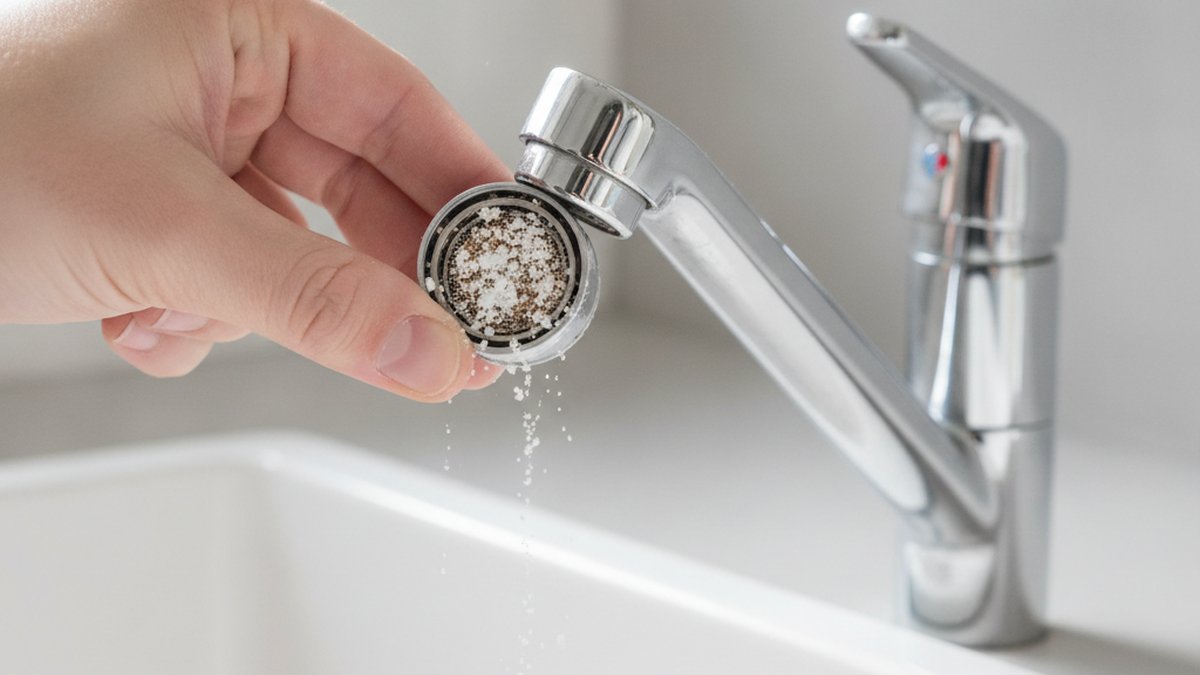
If your kitchen faucet has low water flow, start by unscrewing the aerator at the tip of the spout and checking it for mineral scale and debris — that single part causes most weak-flow complaints, and cleaning or replacing it usually restores full pressure in minutes. Below, I’ll walk you through every likely cause in the order you should check them, from the 30-second fixes to the ones worth a closer look, so you don’t waste time (or money on a service call) chasing the wrong thing.
I’ve replaced, repaired, and tested hundreds of kitchen faucets, and the pattern almost never changes: people assume “low pressure” means a big plumbing problem, when it’s really a tiny screen full of grit. Let’s diagnose it properly.
Why does my kitchen faucet suddenly have low water flow?
A sudden drop in flow — where the faucet was fine last week and is now a trickle — is almost always a clog, not a pressure loss. Debris shakes loose inside the pipes (especially after nearby plumbing work or a water main repair), then collects in the two narrowest points in the whole system: the aerator screen and the spray head.
Here’s the quick logic. If both hot and cold are weak, the blockage is downstream of where they mix — think aerator, spray head, or spout. If only the hot side is weak, the problem is usually the water heater or the hot supply line, not the faucet. If only cold is weak, check the cold shut-off valve under the sink. This one test narrows it down fast.
- Both sides weak → aerator, spray head, cartridge, or spout blockage
- Hot only weak → water heater sediment or hot shut-off valve
- Cold only weak → cold shut-off valve or cold supply line
- Every faucet in the house weak → whole-house pressure or a municipal issue, not this faucet
How do I clean a clogged faucet aerator to fix low flow?
Unscrew the aerator by hand (turn clockwise as you look up at it, or counterclockwise from above), rinse the screen, soak it in white vinegar for 20–30 minutes to dissolve mineral scale, scrub with an old toothbrush, then reinstall. This alone fixes the majority of low-flow faucets, especially in hard-water regions.
If it’s on tight, wrap the aerator in a cloth or a strip of tape to protect the finish, then use pliers gently. Take a photo of the parts as they come out so you stack them back in the right order — most aerators have a screen, a flow restrictor disc, and a rubber washer.
One important note for the U.S.: standard kitchen faucets are capped at 1.8 gallons per minute (GPM) by federal efficiency rules (some states like California cap kitchen faucets at 1.8 GPM as well). That flow restrictor disc inside the aerator is what enforces the limit. Do not drill it out — you’ll violate code and often make the stream splashy without meaningfully improving usable flow. If your aerator is genuinely damaged, buy a replacement matched to your faucet’s thread size (male vs. female) rather than modifying it.
My pull-down sprayer has weak flow — what’s wrong?
On a pull-down or pull-out kitchen faucet, weak flow from the spray head usually means the spray face is clogged with limescale, or the hose has a kink or a leak behind the wand. Rubber-nub spray faces are easy: run your thumb firmly across the nozzles while the water runs to pop scale out of each hole.
If the wand still runs weak after cleaning, pull the hose fully out from under the sink and check for a tight bend, a pinch against the cabinet, or the quick-connect fitting not fully seated. A hose that leaks under the counter will also starve the spray head of pressure. On many models the wand itself has its own tiny aerator or a diverter that can gum up — worth a look before you blame the faucet body.
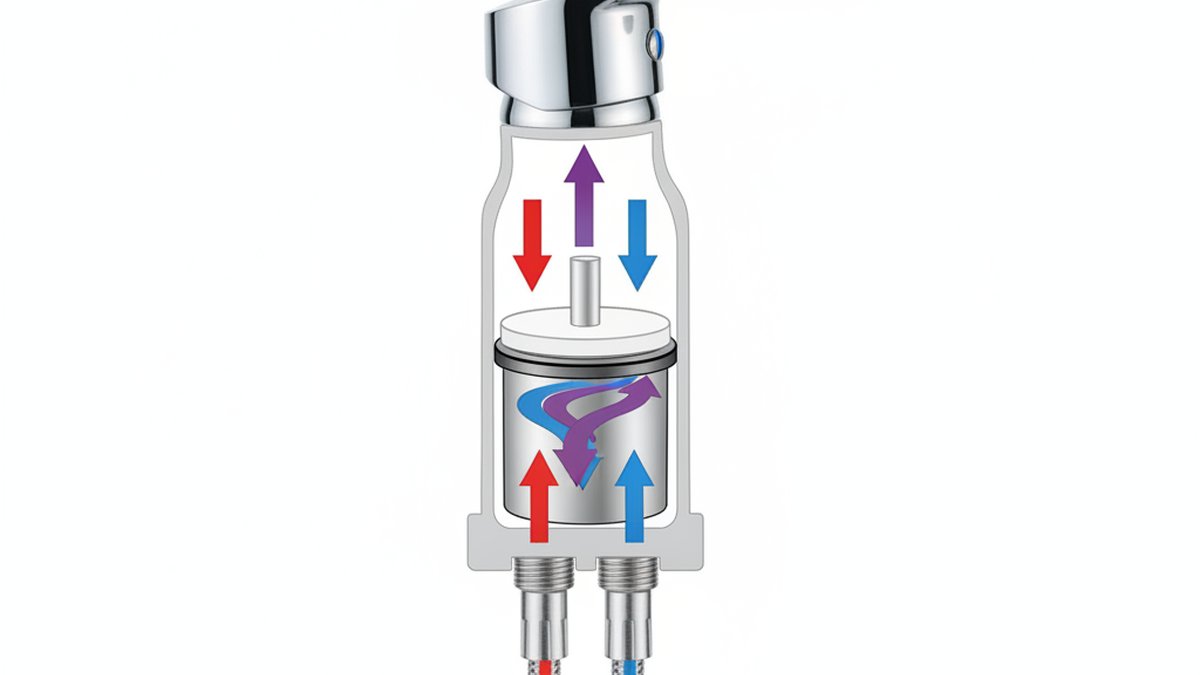
If your faucet is older and the problem keeps returning, the internal cartridge may be the real issue. The cartridge controls flow and temperature, and a worn or scaled one restricts water even when everything downstream is clean. Our guide on what the cartridge on a kitchen faucet actually does explains how to tell, and if you decide to swap it, replacing the cartridge in a kitchen faucet is genuinely a beginner job you can finish in under an hour.
Could the shut-off valves under the sink be the problem?
Yes — a shut-off valve that isn’t fully open is one of the most overlooked causes of low kitchen faucet flow. Reach under the sink, find the two valves (hot and cold) on the supply lines, and turn each one counterclockwise until it stops. Partially closed valves throttle flow exactly like a clog, and they get bumped closed surprisingly often when you store things under the sink.
While you’re down there, run your fingers along the braided supply lines. A kinked, crushed, or corroded supply hose chokes flow just as effectively as a bad valve. These lines are cheap — usually under $15 — and replacing one takes about ten minutes with an adjustable wrench. If a valve is old, stiff, or weeping, that’s a sign it may be partially seized internally; replacing the valve itself is a bigger job but sometimes the true fix.
How do I tell the difference between a clog, a bad cartridge, and low house pressure?
Test in this exact order and you’ll isolate the cause without guessing. Each step rules out a whole category of problem.
| Symptom you observe | Most likely cause | Typical fix | Time / cost |
|---|---|---|---|
| Flow improves a lot with the aerator removed | Clogged aerator | Clean or replace aerator | 10 min / $5–12 |
| Aerator is clean but spray wand still weak | Clogged spray face or kinked hose | Descale wand, straighten hose | 15 min / $0 |
| Both hot & cold weak, aerator clean | Worn/scaled cartridge | Replace cartridge | 30–60 min / $15–40 |
| Only hot OR only cold is weak | Shut-off valve or supply line | Open valve fully / replace line | 10 min / $0–15 |
| Every faucet in the house is weak | Whole-house pressure / PRV / municipal | Check pressure regulator, call utility | Varies |
| Weak flow plus brown/gritty water | Pipe corrosion or water heater sediment | Flush heater / inspect pipes | 1–2 hrs |
A cheap pressure gauge that screws onto a hose bibb settles the “is it my faucet or my house?” question for good. Normal residential water pressure runs about 40–60 psi. If you read 40+ psi at the outdoor spigot but a trickle at the kitchen, the problem is definitely at the faucet, not the supply.
Is hard water the real reason my kitchen faucet keeps clogging?
Often, yes. If you have hard water, dissolved calcium and magnesium precipitate into scale that builds up on aerator screens, spray nozzles, and cartridge internals — so the same faucet clogs again a few months after you clean it. That repeat pattern is the tell-tale sign of hard water, not a defective faucet.
Short term, vinegar soaks handle it. Longer term, consider a whole-house or under-sink water treatment approach, and choose faucet finishes and cartridges rated to resist scaling. Ceramic-disc cartridges hold up far better than older rubber-washer designs in hard water. If clean drinking water is also a goal, a dedicated filtered tap alongside your main faucet can help — our look at whether a chrome drinking faucet is the best choice for clean tap water covers that setup.
Flow rate expectations matter too. If you’re comparing faucets or wondering whether a spec sheet number is “enough,” our breakdown of the Hansgrohe Cento kitchen faucet flow rate is a useful reference point for what a busy kitchen actually needs versus what the label promises. And if you’ve decided your faucet is simply past its prime, our full guide to choosing a kitchen faucet walks through fit, features, and installation.
Step-by-step: fixing a low-flow kitchen faucet yourself
Here’s the whole process in order. Stop as soon as the flow returns to normal — you may not need every step.
- Test hot vs. cold separately. Note whether one side or both are weak — this points you at the right cause immediately.
- Remove and inspect the aerator. Run the faucet with it off. If flow jumps, clean or replace it.
- Clean the aerator. Soak in white vinegar 20–30 minutes, scrub, rinse, reinstall in the correct order.
- Descale the spray head (pull-down/pull-out models). Rub the nozzles, check the hose for kinks.
- Open the shut-off valves fully. Turn both counterclockwise until they stop; inspect supply lines for kinks.
- Check house pressure. Use a gauge at an outdoor spigot; confirm 40–60 psi.
- Replace the cartridge if flow is still weak on both sides with everything else clean.
Turn off the shut-off valves and open the faucet to relieve pressure before removing any internal parts, and keep a towel and a small bowl handy to catch drips and loose components. If you reach the cartridge step and your faucet is a common brand, a matched replacement cartridge is inexpensive and widely available.
When is low kitchen faucet flow a bigger plumbing problem?
If cleaning the aerator, spray head, valves, and cartridge doesn’t restore flow — and other faucets are affected too — you’re likely looking at a whole-house issue: a failing pressure-reducing valve (PRV), partially closed main valve, sediment-filled water heater, or corroded galvanized pipes in older homes. These are worth a licensed plumber’s attention.
A quick warning sign: if you also see discolored or gritty water, the pipes themselves may be corroding internally, which narrows their diameter and permanently reduces flow. That’s not a faucet fix — it’s a repiping conversation. But that’s rare, and it’s the last thing to suspect, not the first. Work the cheap, fast checks first; the odds are overwhelmingly in your favor that it’s an aerator.
FAQ
Why does my kitchen faucet have low water flow but good pressure everywhere else?
Because the restriction is inside that specific faucet — almost always a clogged aerator or spray head, sometimes a partially closed shut-off valve under that sink. When every other fixture is strong, you can rule out whole-house pressure entirely and focus on the faucet’s own screen, cartridge, and supply lines.
Can a clogged aerator really cause this much of a flow drop?
Absolutely — the aerator is the narrowest point water passes through, so even a thin layer of mineral scale or a few grains of grit can cut the stream to a trickle. Removing the aerator and seeing the flow jump back to full is the single fastest way to confirm it’s the cause.
Should I remove the flow restrictor to get more water?
No. The flow restrictor keeps your faucet compliant with the U.S. 1.8 GPM standard, and removing it usually just makes the stream splash without adding useful flow. Clean it instead — a scaled-up restrictor cleaned in vinegar performs like new while staying code-compliant.
How often should I clean my faucet aerator in a hard-water area?
Every 3–6 months if you have hard water, or whenever you notice flow starting to weaken. Setting a recurring reminder saves you the sudden “why is my faucet a trickle?” surprise, and a quick vinegar soak takes only a few minutes.
Is it worth replacing the cartridge, or should I just buy a new faucet?
Replace the cartridge first — it costs $15–40, takes under an hour, and fixes flow and drip problems on an otherwise good faucet. Only buy a new faucet if the body is corroded, the finish is failing, or you want new features like a pull-down sprayer or touchless operation.
My faucet flow is fine but only on cold — is that normal?
No, uneven flow points to something on that one side. Weak cold usually means a partially closed cold shut-off valve or a kinked cold supply line; weak hot points to the water heater or hot supply line. Isolating which side is affected tells you exactly where to look.
About the author: This guide was written by the WOWOW Faucet product and testing team, drawing on hands-on repair and bench-testing of hundreds of kitchen and bathroom fixtures. WOWOW designs and manufactures faucets and bathroom fixtures built to U.S. plumbing standards, and our products are engineered around ceramic-disc cartridges and lead-free waterways that meet cUPC and NSF/ANSI compliance. Every WOWOW kitchen faucet is flow-tested before it ships and backed by our manufacturer warranty — so if a genuine defect (not a cleanable clog) is causing your low flow, we stand behind it.