 WOWOW Faucets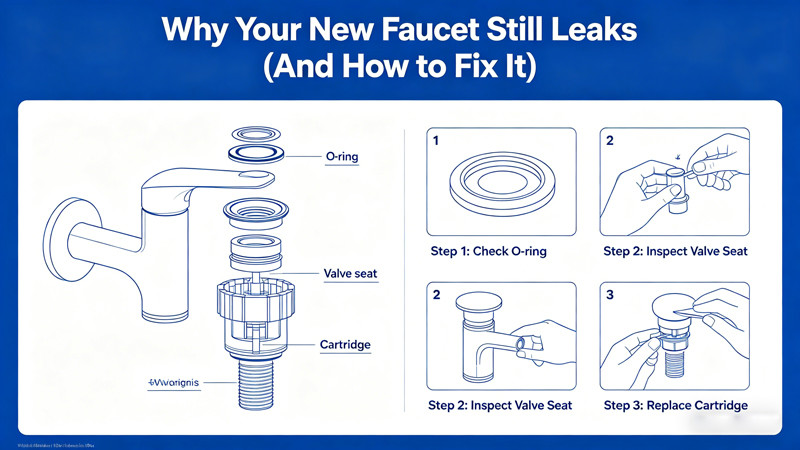
You just installed a brand-new faucet, turned on the water, and… it still leaks. Few things are more frustrating. A new faucet is supposed to solve problems—not create them. The good news is that a leak after installation is very common and usually has a simple explanation. In most cases, it’s not a defective faucet—it’s a small issue with installation, pressure, or internal components.
Let’s break down the real reasons why your new faucet still leaks and how to fix each one.
1. Loose Connections
The most common cause of leaks is loose fittings. During installation, connections under the sink—especially water supply lines—may not be tightened enough.
Signs:
- Water dripping under the sink
- Moisture around connection points
- Leak starts immediately after installation
Fix:
Use an adjustable wrench to gently tighten all connections:
- Hot and cold supply lines
- Mounting nuts
- Hose connections (if applicable)
⚠️ Be careful not to over-tighten. Too much force can damage threads or crush seals.
2. Improperly Seated Cartridge
Modern faucets rely on a cartridge to control water flow. If the cartridge isn’t aligned or fully seated, water can pass through even when the faucet is turned off.
Signs:
- Dripping from the spout
- Leak continues even when handle is off
- No visible leak under the sink
Fix:
- Turn off water supply
- Remove the handle and access the cartridge
- Reinstall it carefully, ensuring proper alignment
- Tighten the retaining nut securely
Even a slight misalignment can cause a steady drip.
3. Damaged or Misplaced O-Rings
Inside the faucet are small rubber seals called O-rings. These are critical for preventing leaks.
Problems occur when:
- O-rings are twisted or pinched during installation
- They are dry and not lubricated
- They were damaged or defective from the start
Fix:
- Disassemble the faucet spout
- Inspect O-rings for cracks or deformation
- Replace if necessary
- Apply silicone plumber’s grease before reassembly
This simple step often solves persistent leaks.
4. Debris in the Water Lines
During installation, debris like:
- Pipe residue
- Sand or dirt
- Old mineral buildup
can enter the faucet and prevent valves from sealing properly.
Signs:
- Irregular dripping
- Reduced water flow
- Faucet leaks despite proper installation
Fix:
- Turn off water
- Remove the faucet aerator
- Flush water lines for a few minutes
- Clean internal components if needed
Flushing the system can clear out hidden particles causing the leak.
5. Water Pressure Too High
High water pressure can force water through seals—even in a new faucet.
Signs:
- Dripping from spout when off
- Loud water noise in pipes
- Sudden bursts of strong flow
Most homes should have water pressure between 40–60 PSI.
Fix:
- Use a pressure gauge to check your system
- Install a pressure regulator if needed
- Adjust your home’s main water valve
Excess pressure is a hidden cause many people overlook.
6. Incorrect Installation of Supply Lines
If supply hoses are:
- Cross-threaded
- Bent too sharply
- Installed at the wrong angle
they may not seal properly.
Signs:
- Leak under the sink
- Drips at hose connections
- Water pooling near valves
Fix:
- Remove and reinstall hoses carefully
- Ensure threads are aligned properly
- Hand-tighten first, then lightly tighten with a wrench
Proper alignment is key to preventing leaks.
7. Faulty or Low-Quality Faucet
While less common, sometimes the issue is the faucet itself. Manufacturing defects can happen, especially in lower-cost models.
Possible defects:
- Poorly made cartridge
- Weak internal seals
- Imperfect valve housing
Signs:
- Leak persists after all fixes
- No visible installation errors
- Brand-new faucet fails immediately
Fix:
- Contact the manufacturer for warranty support
- Replace the faulty part (usually the cartridge)
- Consider upgrading to a higher-quality model
8. Faucet Base Not Properly Sealed
If water leaks around the base of the faucet, the issue may be with the seal between the faucet and sink.
Causes:
- Missing gasket
- Improper use of plumber’s putty
- Uneven sink surface
Fix:
- Remove the faucet
- Apply plumber’s putty or install a rubber gasket
- Reinstall and tighten evenly
This prevents water from seeping under the faucet.
9. Handle Not Fully Closing
Sometimes the faucet handle doesn’t fully shut off water flow due to incorrect positioning.
Signs:
- Slight drip from spout
- Handle feels loose or misaligned
Fix:
- Remove and reposition the handle
- Ensure it aligns correctly with the cartridge
- Tighten securely
A small adjustment can stop the leak completely.
10. Normal Residual Dripping
Not all dripping is a problem. Many faucets—especially high-arc or pull-down designs—retain a small amount of water after use.
Signs:
- Drips for a few seconds after turning off
- Stops quickly on its own
- No continuous leaking
This is normal and not a defect.
Final Thoughts: Why Your New Faucet Still Leaks
A leaking faucet right after installation can feel like a major issue, but in most cases, it’s caused by small, fixable problems such as:
- Loose connections
- Misaligned cartridge
- Damaged O-rings
- Debris in the system
- High water pressure
Before replacing the faucet, it’s worth going through these checks step by step. Most fixes take less than an hour and require only basic tools.
A properly installed faucet should be smooth, quiet, and leak-free. Once everything is aligned, tightened, and cleaned, your new faucet should perform exactly as expected—no drips, no frustration.
Fixing the issue yourself not only saves money but also gives you a better understanding of how your plumbing works—making future repairs even easier.\n
Related Guides
\n
- \n
- How to Fix A Leaky Faucet
- How Do I Fix a Leaky Faucet Cartridge Handle Myself in Under an Hour?
- How to Fix Fluctuating Water Pressure: A Complete Guide
\n
\n
\n
\n