 WOWOW Faucets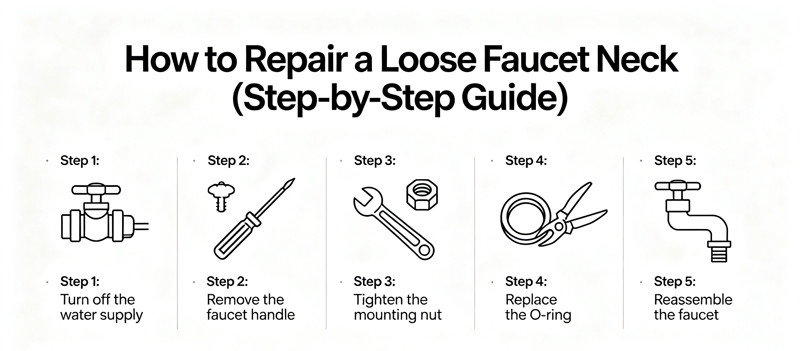
A loose faucet neck—also called the spout—can turn everyday tasks into a frustrating experience. If your faucet wobbles, shifts side to side, or feels unstable when you use it, the problem usually comes down to a few common issues: worn parts, loose connections, or improper installation. The good news is that fixing a loose faucet neck is often simple and doesn’t require replacing the entire fixture.
This guide will walk you through the causes, tools, and step-by-step solutions to get your faucet stable again.
What Is a Faucet Neck?
The faucet neck (or spout) is the curved or straight section where water flows out. In many kitchen and bathroom faucets, the neck is designed to swivel for convenience. Over time, movement, wear, and water pressure can cause it to loosen.
Common Causes of a Loose Faucet Neck
Before jumping into repairs, it helps to understand what’s causing the issue:
1. Loose Retaining Nut
Underneath the sink or inside the faucet body, a retaining nut holds the spout in place. If this loosens, the entire neck becomes unstable.
2. Worn O-Rings
O-rings are small rubber seals that help stabilize and seal the spout. When they wear out, the faucet may wobble or leak.
3. Missing or Damaged Bushings
Some faucets use plastic or nylon bushings to keep the spout aligned. If these break or wear down, the neck can feel loose.
4. General Wear and Tear
Frequent swiveling and long-term use naturally loosen internal components.
5. Improper Installation
If the faucet wasn’t tightened correctly during installation, it may become loose over time.
Tools You’ll Need
Most repairs require only basic tools:
- Adjustable wrench
- Allen wrench (hex key)
- Screwdriver
- Plumber’s grease (silicone-based)
- Replacement O-rings (if needed)
- Flashlight
Step-by-Step: How to Fix a Loose Faucet Neck
Step 1: Turn Off the Water Supply
Before starting any repair, shut off the water valves under the sink. Turn on the faucet briefly to release any remaining pressure.
Step 2: Identify the Faucet Type
There are two main designs:
- External mount faucets: The spout connects visibly at the base
- Internal mount faucets: The securing components are hidden inside the body
Understanding your faucet type helps you locate the source of looseness.
Step 3: Check for a Set Screw
Many faucet necks are held in place by a small set screw, usually located at the back or base of the spout.
- Use an Allen wrench to tighten it
- Turn clockwise gently until snug
⚠️ Avoid over-tightening, as this can strip the screw or crack internal parts.
Step 4: Tighten the Retaining Nut
If the set screw isn’t the issue, the retaining nut underneath the faucet is likely loose.
- Crawl under the sink with a flashlight
- Locate the nut holding the faucet assembly
- Use an adjustable wrench to tighten it
This step often solves wobbling problems immediately.
Step 5: Remove the Spout
If tightening doesn’t fix the issue, you may need to remove the faucet neck:
- Loosen the set screw (if present)
- Gently pull the spout upward
- Wiggle slightly if it feels stuck
Be careful not to force it, as internal parts can be damaged.
Step 6: Inspect O-Rings and Bushings
Once the spout is removed, check the internal components:
- Look for cracked or flattened O-rings
- Check for worn or missing bushings
- Clean away any debris or mineral buildup
If parts look damaged, replace them with matching components from a hardware store.
Step 7: Apply Plumber’s Grease
Before reassembling:
- Apply a thin layer of silicone plumber’s grease to O-rings
- This helps create a better seal and smoother movement
Avoid petroleum-based grease, as it can damage rubber.
Step 8: Reassemble the Faucet
- Slide the spout back into place
- Ensure it sits evenly and aligns correctly
- Tighten the set screw and retaining nut
Test the movement—it should swivel smoothly but feel firm.
Step 9: Turn Water Back On and Test
Turn the water supply back on and test:
- Check for wobbling
- Look for leaks around the base
- Run both hot and cold water
If everything feels stable and dry, the repair is complete.
When to Replace Instead of Repair
Sometimes repair isn’t the best option. Consider replacing the faucet if:
- The internal housing is cracked
- Replacement parts are unavailable
- The faucet is very old or low quality
- The looseness keeps returning after multiple fixes
A new faucet can save time and provide better long-term reliability.
Preventing a Loose Faucet Neck
Once you’ve fixed the issue, a few habits can help prevent it from happening again:
- Avoid excessive force when turning or moving the spout
- Clean and maintain O-rings periodically
- Check and tighten fittings every few months
- Use gentle motion instead of forcing rotation
Regular maintenance goes a long way in extending faucet lifespan.
Final Thoughts
A loose faucet neck might seem like a major problem, but it’s usually caused by small, fixable issues like a loose nut or worn O-rings. With basic tools and a bit of patience, most homeowners can handle this repair without professional help.
The key is to approach the problem step by step—tighten what’s loose, replace what’s worn, and make sure everything is properly aligned during reassembly. Once fixed, your faucet should feel solid, stable, and reliable again.
Taking the time to repair rather than replace not only saves money but also helps you better understand how your plumbing fixtures work—making future fixes even easier.\n
Related Guides
\n
- \n
- How to Fix A Leaky Faucet
- How Do I Fix a Leaky Faucet Cartridge Handle Myself in Under an Hour?
- How to Fix Fluctuating Water Pressure: A Complete Guide
\n
\n
\n
\n